Bank and financial building roofing in Birmingham, AL. Small high-visibility roofs and drive-through canopies, with work scheduled around branch hours and security. The plan is tailored to hours of operation, occupants, deliveries, rooftop equipment, interior sensitivity, and the owner's budget horizon.
Bank and Financial Building Roofing Across Birmingham's Branch Network
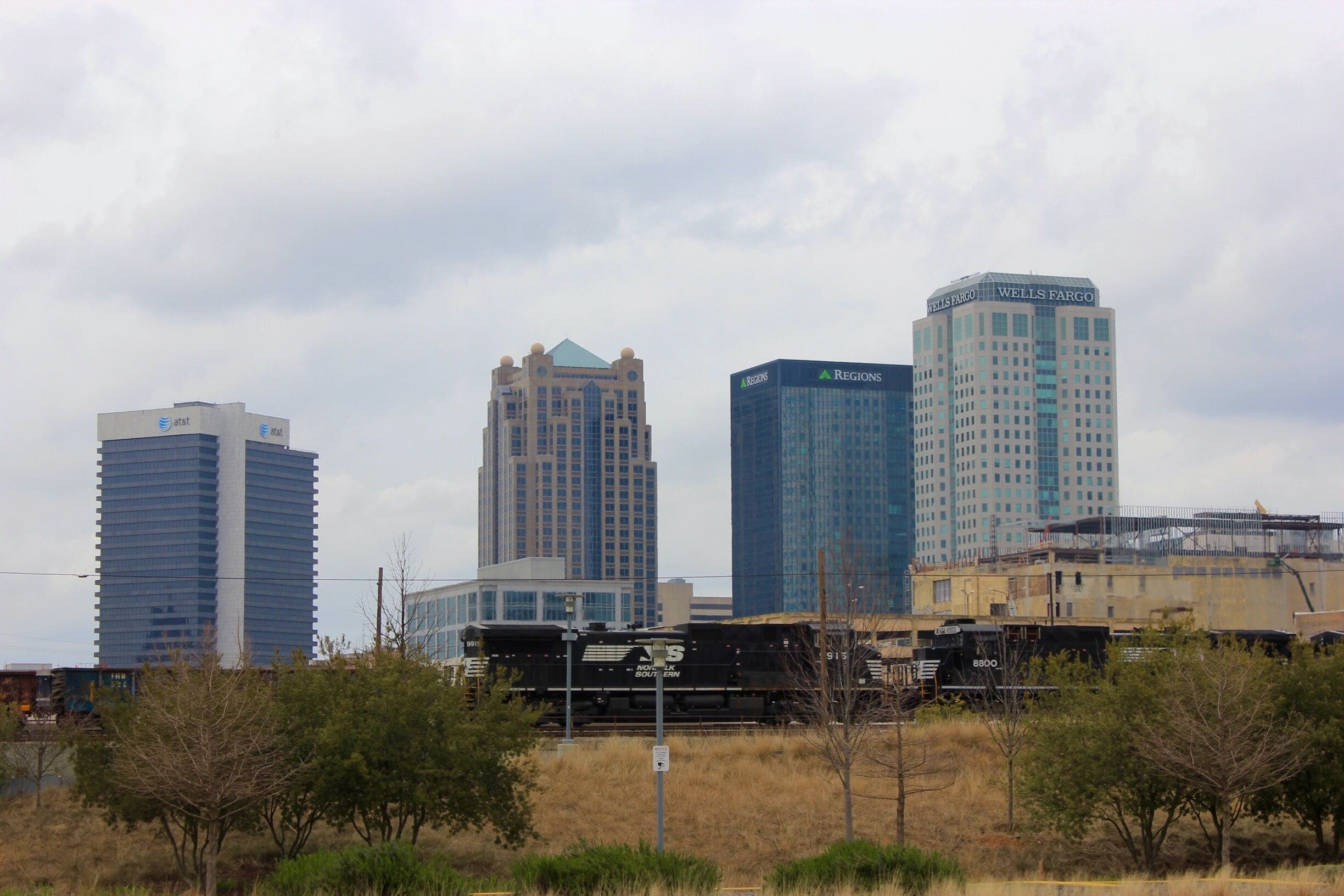
A bank roof is small, flat, and far more visible than its size suggests. Birmingham is a serious financial town — it is the home of Regions Financial, the headquarters base for several regional banks, and a downtown core where institutional towers along 20th Street and First Avenue sit alongside a wide network of neighborhood branches stretching through Vestavia Hills, Hoover, Homewood, and out the U.S. 31 corridors. Those branches are where most of our financial roofing work happens, and they share a profile: a compact low-slope roof, a customer-facing building that has to look immaculate, and a drive-through canopy that is a roof in its own right.
Small Roof, High Stakes
The square footage of a branch roof is modest, but the consequences of a leak are not. Inside a bank are server rooms, the network equipment that connects the branch to the institution, document storage, and the vault. A leak over any of that is not a stained ceiling tile — it is a technology outage, a compliance problem, and potentially damaged records in a regulated business. Banks also cannot simply close a branch for days to chase a roof problem; the lobby has to open on schedule. So while the roof is small, we treat it with the seriousness of the operations underneath it. There is no low-stakes leak in a financial building.
Branch roofs are also unusually visible. A bank invests heavily in the appearance of its building because the building is a statement about the institution's stability. A roof edge with peeling coping, a stained parapet, or a sagging canopy fascia undercuts that message every time a customer pulls into the lot. We roof these buildings knowing the appearance of the edge details and the canopy matters almost as much as the watertightness behind them.
The Drive-Through Canopy Is Its Own Roof
Nearly every Birmingham branch has a drive-through, and that canopy over the teller lanes and ATMs is a small roof that gets ignored until it fails. It is fully exposed on all sides, it takes wind uplift from every direction with nothing to shelter it, and its underside and fascia are in plain view of every customer in the lane. The flashing where the canopy ties back to the main building is a common leak point, and a leaking canopy drips directly onto customers and onto the ATM and pneumatic-tube equipment below. We inspect and detail canopies as carefully as the main roof, because a customer staring up at a stained, dripping canopy soffit forms an impression of the whole bank in that moment.
Membrane Choices for Branch Roofs
The low-slope roofs over Birmingham branches are well suited to single-ply membranes, and we install both TPO and EPDM depending on the building and the institution's preferences.
TPO for a Clean, Reflective Surface
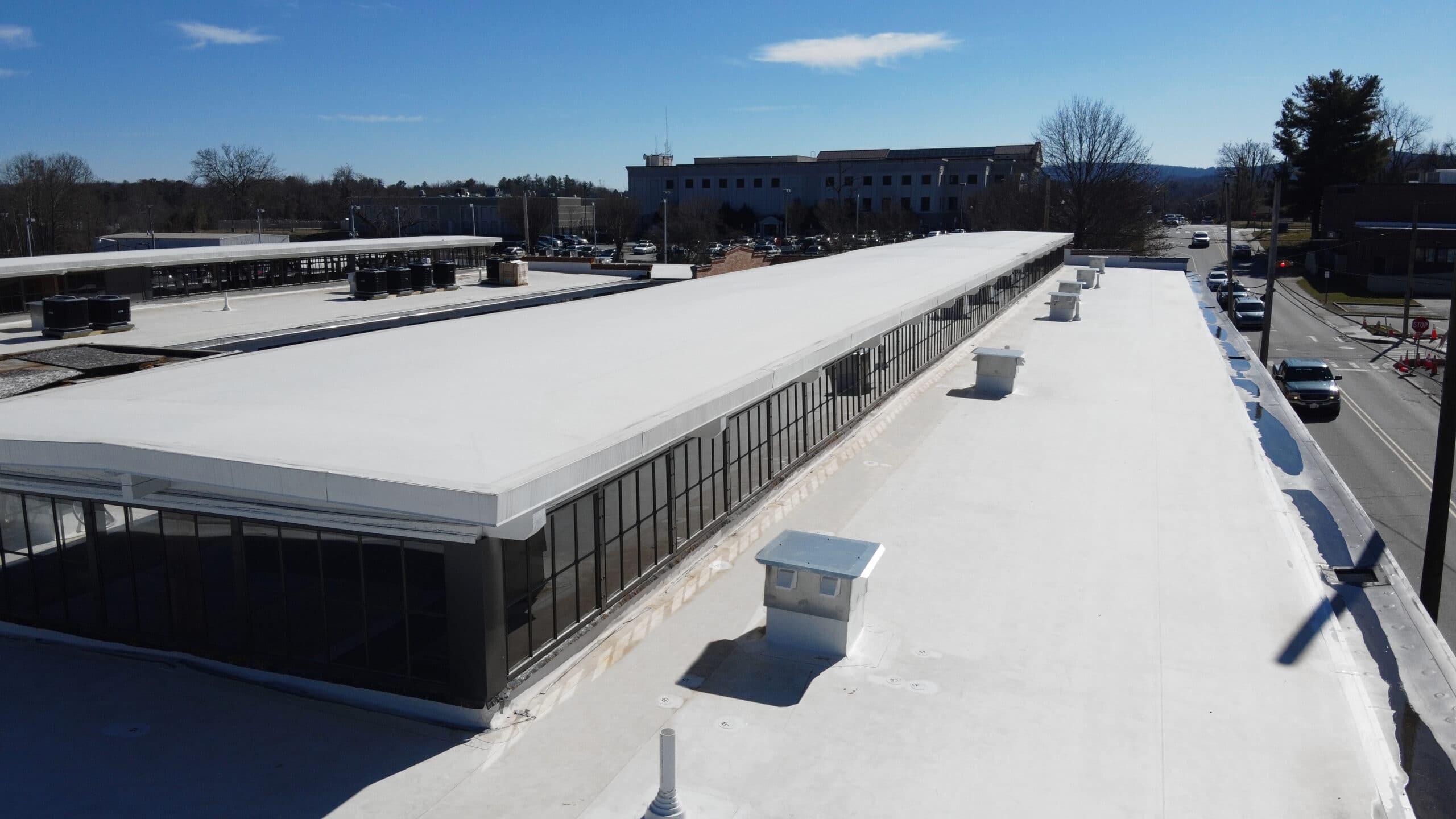
A white TPO membrane reflects the central Alabama summer sun off a roof that often sits directly over the server room and the most climate-sensitive equipment in the branch. Keeping that roof cooler eases the cooling load on the spaces below and reduces thermal stress on a small membrane field. We hot-air weld and probe every seam. On a roof this compact, a single bad detail around the rooftop unit or the canopy tie-in represents a large share of the total risk, so our seam and flashing discipline is exacting.
EPDM for Durability and Clean Detailing
EPDM rubber gives a durable, long-lived membrane that handles thermal movement well and detail cleanly around the penetrations a branch carries. For an institution that values a low-maintenance, proven system, EPDM is a strong choice, and its large sheets mean few field seams on a small roof — fewer potential leak paths over sensitive equipment.
Under either membrane we build positive drainage with tapered insulation where needed. A small flat roof that ponds against a parapet over a server room is asking for trouble, and clean drainage on a compact roof is straightforward to build correctly when it is planned from the start.
Security, Discretion, and Scheduling
Roofing a bank means working at a secured site with cameras, alarms, and access protocols, and we plan around that. We coordinate access in advance, our crews understand they are working at a sensitive facility, and we keep our footprint on the property tight and professional. Many branches prefer that the bulk of disruptive work — tear-off, crane lifts, anything noisy — happens outside banking hours or on weekends so the lobby experience stays calm during business. We schedule to the branch's rhythm and we keep the lot and entrances clear during open hours so customers and the drive-through lane are never blocked.
We also keep the work clean and contained. A financial building's exterior is part of its brand, and a job site strewn with debris in the parking lot sends the wrong signal. We stage materials neatly, protect the landscaping and the drive-through equipment, and leave the site looking like a bank at the end of every day.
Protecting the Equipment Below
Because the highest-value, most leak-sensitive spaces in a branch — the server room, the network closet, the vault — often sit directly under the roof, we plan tear-off and any open work to keep those areas protected at all times. We dry in every open section daily against Birmingham's afternoon thunderstorms and we never leave a deck exposed over a server room overnight. Where work has to happen directly above critical equipment, we coordinate with the branch on temporary protection below. The roof's entire job over a bank is to keep water away from the technology and the records, and we do not compromise that during the project itself.
Recover or Tear Off
When a branch roof reaches the end of its life, we core it to determine whether the insulation is wet before recommending a path. A recover over saturated insulation above a server room only postpones and worsens the damage, and we will tell the institution so directly. If the deck and insulation are dry, a recover can be an economical, lower-disruption option that keeps the branch open. On a small roof the cost difference between recover and tear-off is modest, so we weight the decision toward whatever best protects the sensitive operations underneath rather than toward squeezing another season out of a questionable roof.
After a Storm
Birmingham takes hail and high wind, and a small bank roof and its exposed canopy can both be damaged in a single storm. Hail bruising on a compact membrane and uplift damage on a drive-through canopy are easy to overlook until the next heavy rain finds the server room. After a significant storm we inspect both the main roof and the canopy promptly, document the damage, and help the institution file an accurate insurance claim while the window is open. For a financial building, catching damage early is not just cheaper — it protects the continuity of the branch's operations.
Talk to Us About Your Birmingham Branch or Financial Building
If you manage facilities for a bank, credit union, or financial institution in Birmingham — a downtown building along 20th Street, a branch in Vestavia Hills or Hoover, or a network of locations across the metro — we will inspect the roof and the drive-through canopy, give you a straight read on their condition, and plan any work around your hours, your security, and the sensitive operations inside. Reach out and we will schedule an inspection.