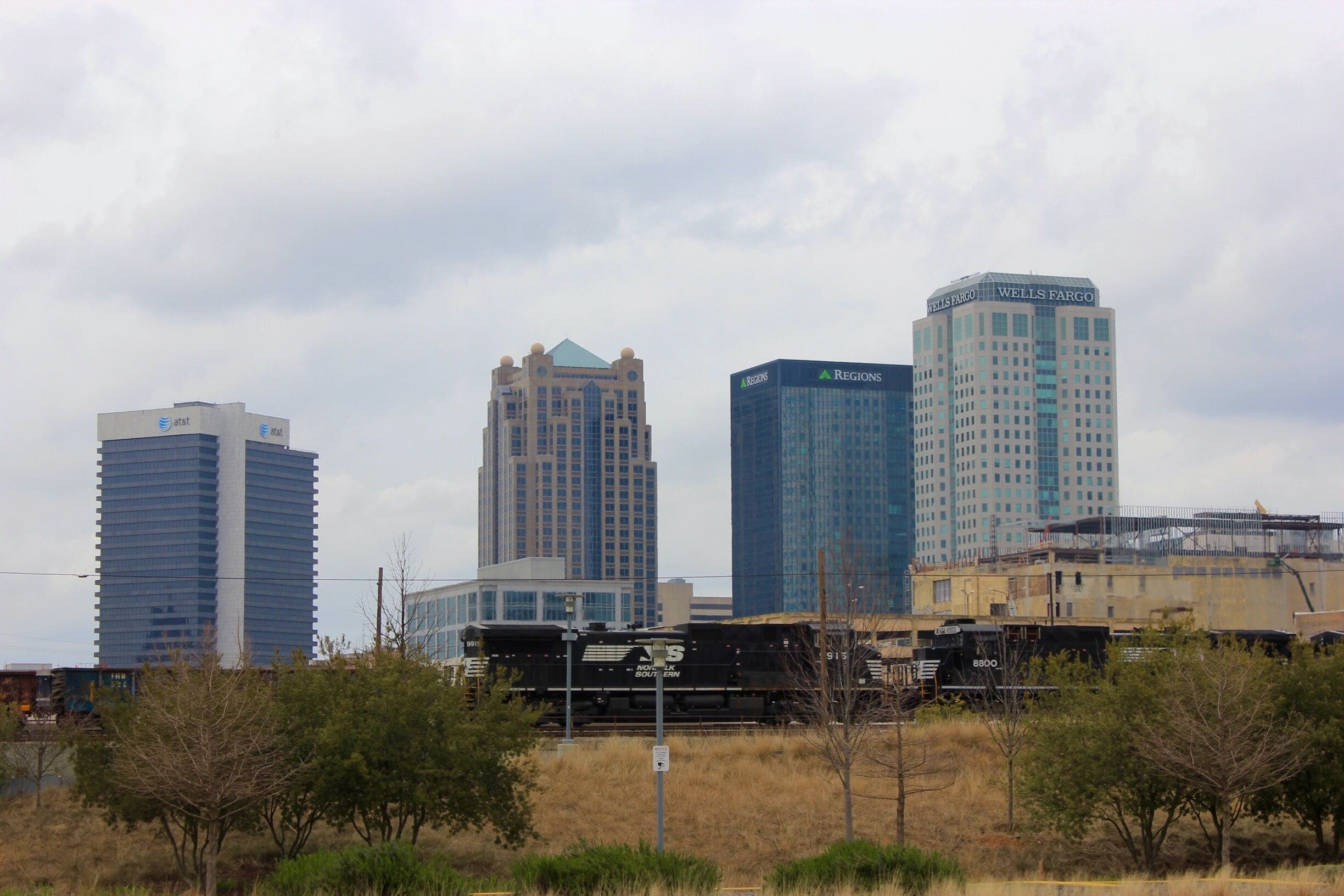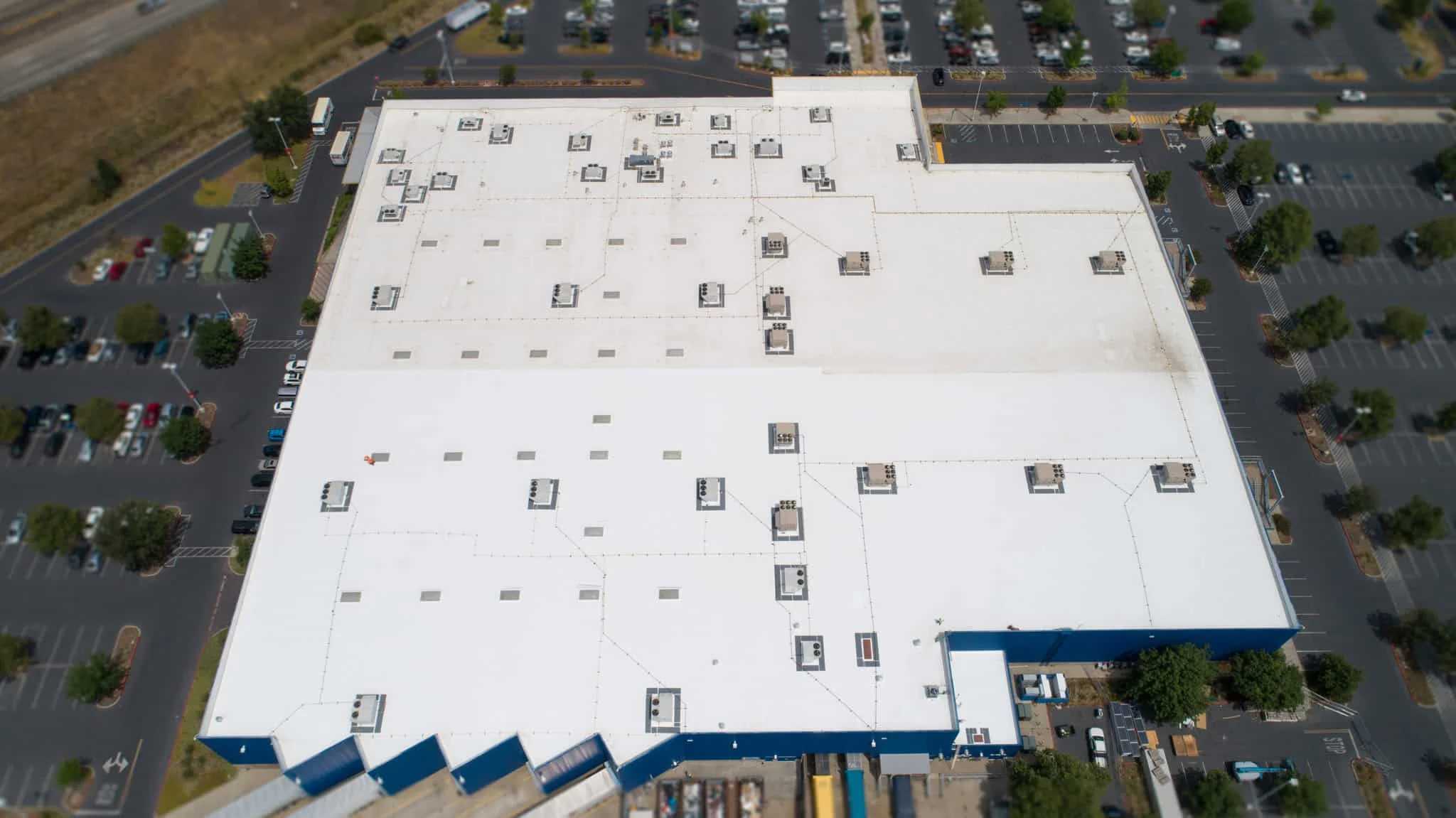
Commercial Re-Roofing for commercial buildings across Birmingham. The work is planned around roof access, active building use, drainage, membrane condition, and the owner's timeline for repair, maintenance, or capital work.
TPO Membrane Thickness — 60-mil vs 80-mil
60-mil TPO is the standard specification for Birmingham commercial buildings — adequate for most warehouse, retail, and office buildings with normal foot traffic and standard rooftop equipment. Carries a 20-year manufacturer NDL warranty from every major manufacturer.
80-mil TPO costs more per square but extends warranty life (up to 25 years from some manufacturers), handles higher mechanical-traffic environments, and provides additional puncture resistance. We specify 80-mil for buildings with heavy rooftop equipment, frequent HVAC maintenance traffic, or owners who want the longer warranty term and lower lifecycle cost over a 25-year capital horizon.
Attachment Methods — Mechanical, Fully Adhered, Ballasted
Mechanically attached: Standard for most Birmingham commercial work. Membrane fastened with screws and plates through the insulation into the deck on a pattern designed against the building's wind-uplift requirement. For Jefferson County tornado-exposure buildings, we design the pattern against the documented worst-case EF3/EF4 exposure from the April 2011 event track, not the minimum code requirement.
Fully adhered: Membrane bonded to the substrate with a TPO-compatible adhesive. Used when the project needs the cleanest finish (no fastener telegraphing through the membrane), when the deck cannot tolerate additional penetrations, or when wind-uplift requirements exceed what mechanical attachment can deliver. More expensive and more sensitive to application temperature — we do not install fully adhered TPO below 40°F substrate, which matters in Birmingham's winter window.
Ballasted: Membrane loose-laid with stone ballast on top. Not appropriate for most Birmingham commercial work because the structural loads are high and future repairs are complicated. We specify ballasted systems only when the engineer of record has confirmed the deck can carry the load.
Common TPO Failures and How We Prevent Them
Seam failure: TPO seams are heat-welded. Cold welds, incorrect roller pressure, or contaminated membrane create seam failures that show up two to five years after installation. Our operators are factory-trained, we test every seam with a 5-lb test wheel during installation, and we probe-test every linear foot of seam before closeout. We do not accept visual-only seam QC.
Flashing detail failure at freeze-thaw cycles: Penetrations, parapets, drains, and curb flashings expand and contract with temperature change. In Birmingham, where temperatures can drop from 50°F to 15°F overnight during a winter storm, rigid flashing details crack. We use pre-formed flexible boots on all pipe penetrations, three-course flashing at all parapets, and manufacturer-spec corner flashing on all inside and outside corners. Each flashing detail is photographed against the manufacturer's spec sheet at closeout.
Hail puncture: Jefferson County spring hail events produce stones in the 1.5-inch to 2.5-inch range in typical years. Standard-density polyiso insulation under TPO will compress on hail impact, causing the membrane above to stretch and crack. We spec HD polyiso or HD gypsum cover board on every installation — the impact-resistance improvement is documented and matters on insurance certificates.
Walkway pad omission: TPO is vulnerable to puncture from concentrated foot traffic to rooftop HVAC units, from maintenance boots, and from equipment drops. We spec walkway pads on every identified traffic path — from roof hatch to every unit requiring regular service.
Frequently asked questions
What manufacturer of TPO do you install in Birmingham?
We install TPO from Carlisle, Johns Manville, Sika Sarnafil, GAF, and Versico. The right manufacturer for a specific building depends on warranty terms, available thickness options, the local manufacturer rep's warranty inspection schedule, and what the building owner's portfolio standard specifies. We recommend based on those criteria, not on who has the best distributor pricing this month.
Can TPO be installed over an existing roof in Birmingham?
Yes, if the existing roof's insulation is dry and the deck is sound. We pull moisture cores during inspection to verify. If the existing roof has wet insulation, a recover traps the moisture and voids the new warranty — full replacement is the correct scope. Wetting percentages above 25% of sampled cores always trigger a replacement recommendation from us.
How long does TPO last in Birmingham's climate?
Modern 60-mil TPO formulations are warranted for 20 years and typically perform 25 to 30 years in Alabama conditions with proper maintenance. The key variable is maintenance: manufacturer NDL warranties require documented annual inspection and maintenance. Buildings that skip maintenance lose the warranty, and the warranty is the most valuable deliverable at closeout — not just for the current owner but for any future buyer at disposition.
Does TPO perform well in Birmingham ice storms?
TPO membrane itself is not damaged by ice or freeze-thaw cycling. The vulnerability points are the flashing details — pipe boots, parapet terminations, drain collars — which can crack if installed with rigid rather than flexible materials. We use flexible pre-formed boots and three-course parapet flashings on every installation specifically to handle the freeze-thaw cycles Birmingham averages every two to four years.