Commercial roofing contractors serving Mountain Brook with commercial roof repair, replacement, coatings, maintenance programs, inspections, and documented roof reports. Roof visits in this area are coordinated around building hours, access points, tenant needs, parking, and weather exposure.
Village Center Buildings — Assessment Before Scope
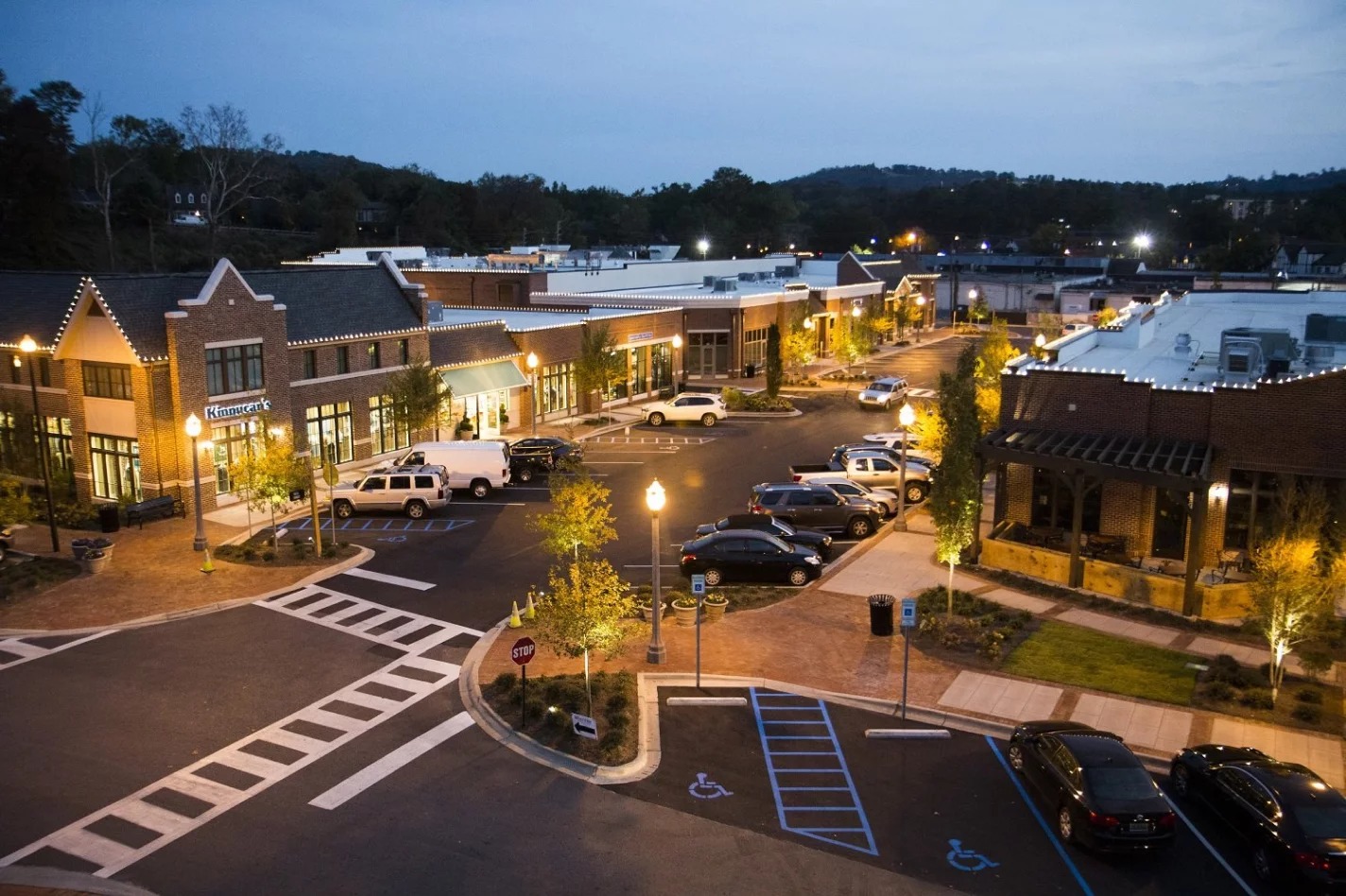
English Village on Cahaba Road includes some of the oldest continuously-occupied commercial buildings in Jefferson County. Construction methods from the 1930s through the 1950s produced structural assemblies that differ significantly from modern commercial construction — dimensional lumber roof framing rather than steel deck, slate and wood-shake remnants under built-up roof layers, and parapet walls tied to masonry that behaves differently under thermal cycling than steel-framed parapets. We do not write replacement scopes for these buildings from street-level observation.
Crestline Village on Montevallo Road has a similar construction profile, with the added complexity of hillside terrain that produces different drainage patterns on each building. Some Crestline buildings have roofs that drain internally — no perimeter scuppers — with interior drain bodies that are the primary maintenance point. If those drain bodies are not cleared and maintained, water ponding above 2 inches on a flat roof voids most manufacturer warranties and, in prolonged events, creates structural loading risk.
Cahaba Village, at the US-280 interchange, is newer construction — predominantly 1980s through 2000s retail and restaurant buildings. This inventory is more conventional: low-slope modified bitumen or early TPO, perimeter drainage, metal deck or wood frame depending on the building. Most of these buildings are approaching or past their first-reroof milestone.
Highway 280 Office Corridor
The office parks along Highway 280 between Mountain Brook and the Vestavia Hills boundary — including the clusters near Cherokee Bend Road and Overton Road — are predominantly 1980s and 1990s two- to four-story office buildings with flat roofs on steel deck. The roof systems here are modified bitumen and early TPO, with most buildings in the 25-to-35-year age range. Many of these buildings are now past their original manufacturer warranty terms and in need of a documented condition assessment to establish whether replacement or recover is the appropriate scope.
We run inspection routes on the Highway 280 corridor on a recurring basis and have condition records on many of the buildings in this cluster. When we walk a building we have assessed previously, the incremental time is lower because we already have the baseline documentation. New accounts in this corridor start with a full roof walk, moisture-core pulls if we suspect saturated insulation, and a written condition report before any scope recommendation.
Frequently asked questions
How do you handle the older construction in Mountain Brook's village centers?
Assessment first. On any building we cannot fully characterize from a roof walk — which includes most English Village and Crestline Village structures — we open inspection ports at the deck to confirm what is there before we write a scope. The cost of pulling two or three inspection ports on the front end is small compared to the cost of finding unexpected deck conditions after mobilization.
Does Mountain Brook have specific permit or visual review requirements for commercial roofing?
Yes. Mountain Brook has its own building department and visual standards review for any work visible from the streetscape. Rooftop equipment, parapet height changes, and visible roofing materials on street-facing slopes are subject to review. We flag these before the permit application. For standard flat-roof replacements not visible from the street, the process is closer to a standard permit.
What is your response time for Mountain Brook commercial lease emergencies?
Same-day mobilization. From our downtown Birmingham office we are 20 minutes from English Village in normal traffic, 25 minutes from Crestline Village, and 280 office corridor near the Vestavia Hills boundary.
Can you work on buildings with interior roof drains?
Yes. Interior drain systems — drain body, leader, and horizontal run to the building's storm drain — require specific inspection protocols that perimeter-drain buildings do not. We inspect every component of an interior drain system, test flow rate, and document any restriction or damage. Drain body replacement on a flat roof is a straightforward scope; ignoring a failing drain body is how a building develops structural loading problems.