Infrared thermography for commercial roof moisture detection in Birmingham - Alabama-specific IR scanning windows, operational limits in summer humidity, and how we combine IR with core sampling for confident moisture mapping. The work focuses on field observations, photos, priorities, and documentation that helps teams make decisions without losing context.
When IR Works in Alabama and When It Does Not
Conditions that produce usable thermograms in Birmingham: At least four hours of direct solar loading on the roof during the day, a temperature differential of 15 to 20°F or more between the cooling roof surface and ambient air at scan time, wind below 15 mph (wind equalizes surface temperatures and suppresses anomaly contrast), no precipitation in the prior 48 to 72 hours (wet membrane surface from rain produces false-positive anomalies across the field), and adequate cloud-free solar loading during the day.
Conditions that reduce thermogram reliability: Birmingham's humid summer evenings where ambient moisture keeps the surface temperature elevated and suppresses differential; overcast or partially overcast days that reduce solar charging of the insulation; and reflective membrane surfaces — white or light-grey TPO and EPDM that have been installed for energy code compliance, which are common on Birmingham commercial buildings constructed after 2010, absorb less solar energy and produce a weaker anomaly signal between wet and dry zones.
Alabama-specific note: Birmingham's summer humidity is a compound problem for IR. Not only does the slow evening cool-down reduce differential, but the ambient moisture from humid air can produce false-positive warm signatures on roofs with minor condensation on the membrane surface. Summer IR surveys in the Birmingham area carry a higher false-positive rate than fall and winter surveys. We assess IR viability for each project before scheduling the scan — if the building and season combination is unfavorable for IR, we tell the owner and recommend direct core sampling at strategic density instead.
The IR-Plus-Core Sampling Workflow
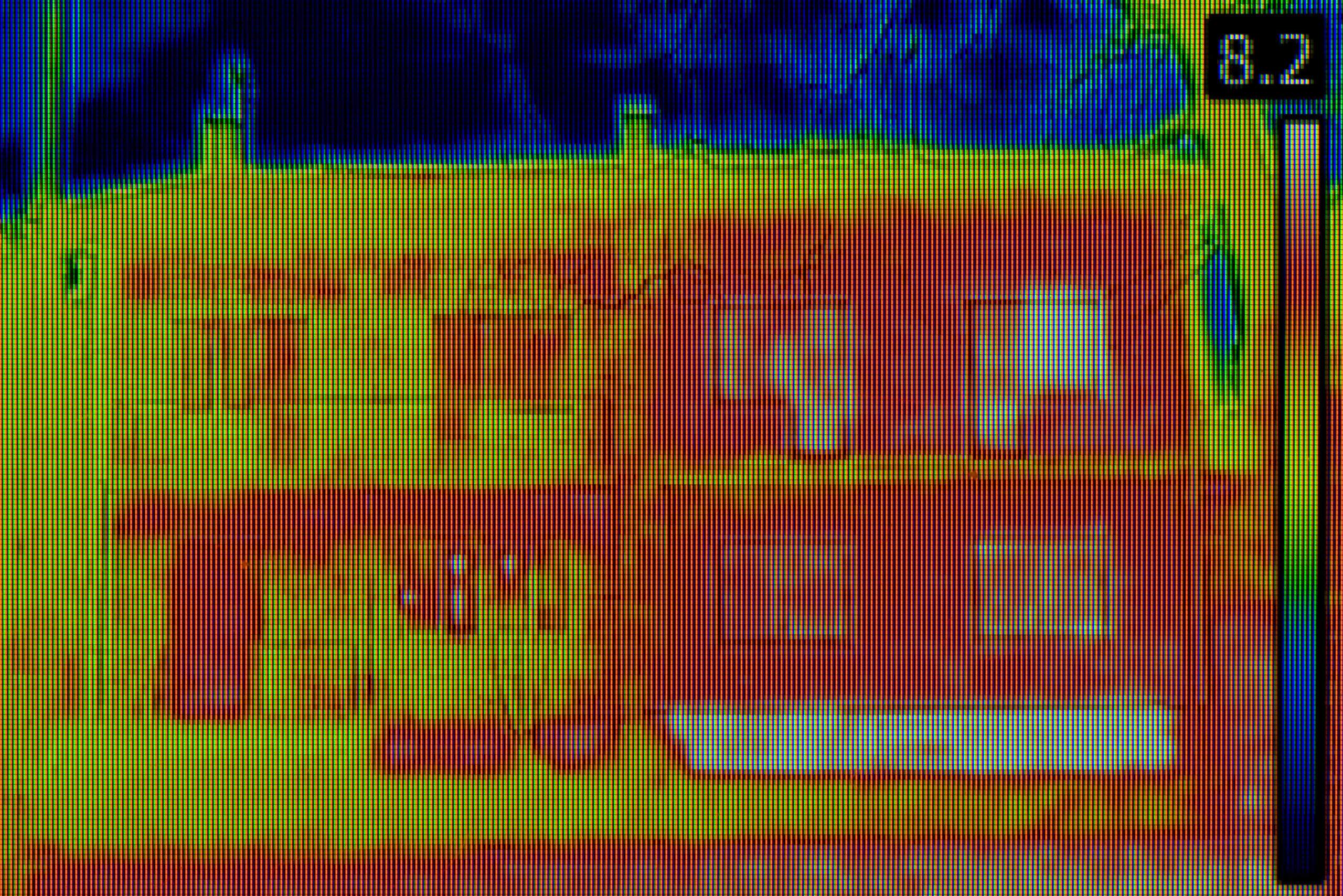
The IR scan produces a thermogram with warm anomaly zones marked as candidate moisture locations. We then pull cores at each significant anomaly zone to confirm the finding. We also pull cores at several presumed-dry zones from the thermogram to validate that the IR read is accurate for that building — on buildings with reflective membranes or anomalous deck assemblies, the IR signal may not reliably distinguish wet and dry zones, and the validation cores catch that problem before we over-sample based on a faulty thermogram.
This combined approach — IR to map, cores to confirm — covers a large Birmingham commercial roof with higher confidence than either tool alone. IR alone produces probable locations without confirmation. A full-density grid of core pulls on a 100,000 sq ft building produces confirmation without the spatial coverage benefit. IR plus targeted cores typically produces equivalent or better confidence at lower core count, which reduces both cost and membrane disruption.
The combined deliverable is a moisture distribution map with each zone coded as confirmed-wet (core-verified), probable-wet (IR anomaly, not yet core-confirmed), or dry (IR and core both clear). The three-level classification tells the owner where the data is definitive and where it is inferred.
Equipment, Scheduling, and Report Format
We use FLIR commercial-grade radiometric thermal cameras calibrated for roofing applications. Thermograms are captured at full radiometric resolution and delivered alongside visible-light photographs of each anomaly location — so every thermal anomaly in the report corresponds to a visible-light image showing the membrane surface condition at that zone.
IR surveys are scheduled in the late-evening window, two to four hours after solar peak. For Birmingham fall and winter projects, the optimal scan window is typically 8 PM to midnight. We coordinate with building security and facility management for after-hours roof access and confirm weather conditions before mobilizing.
The IR report is formatted as an addendum to the building's condition report — the moisture survey findings are integrated into the full condition record rather than filed as a standalone document separate from the inspection history.
Frequently asked questions
What is the best time of year for IR scanning in Birmingham?
October through March is the reliable window in central Alabama. November through February typically produces the best results because daytime temperatures are still sufficient for solar charging of the insulation while evening temperatures drop quickly and clearly. October and March are generally good. April can work in favorable weather conditions. May through September is unreliable — summer humidity and slow evening cool-down suppress the differential that makes wet-zone anomalies detectable.
Can IR detect moisture from Birmingham's summer humidity accumulation?
It can detect it, but the ideal time to scan for that accumulated moisture is fall — after the humid summer has had time to saturate any vulnerable insulation, and when evening temperatures drop fast enough to produce a clear thermogram. A fall IR scan after a humid summer is often the most informative scan timing for Birmingham commercial buildings with aging membrane systems, because the insulation that accumulated moisture over the summer shows clearly against the cooling dry zones.
Is infrared scanning required, or can we just pull cores?
Core sampling without IR is appropriate for most buildings — especially smaller roofs or buildings where prior inspection has already identified probable moisture zones. IR adds the most value on large Birmingham commercial roofs where a full-density core grid would be expensive, and when the scan-season conditions are favorable. We recommend based on the specific building and timing, not as a default upgrade.
Do you carry calibration records for your thermal imaging equipment?
Yes. Calibration records for our thermal imaging equipment are available for any project where the IR report will be used in insurance, legal, or acquisition due-diligence contexts requiring equipment calibration documentation.