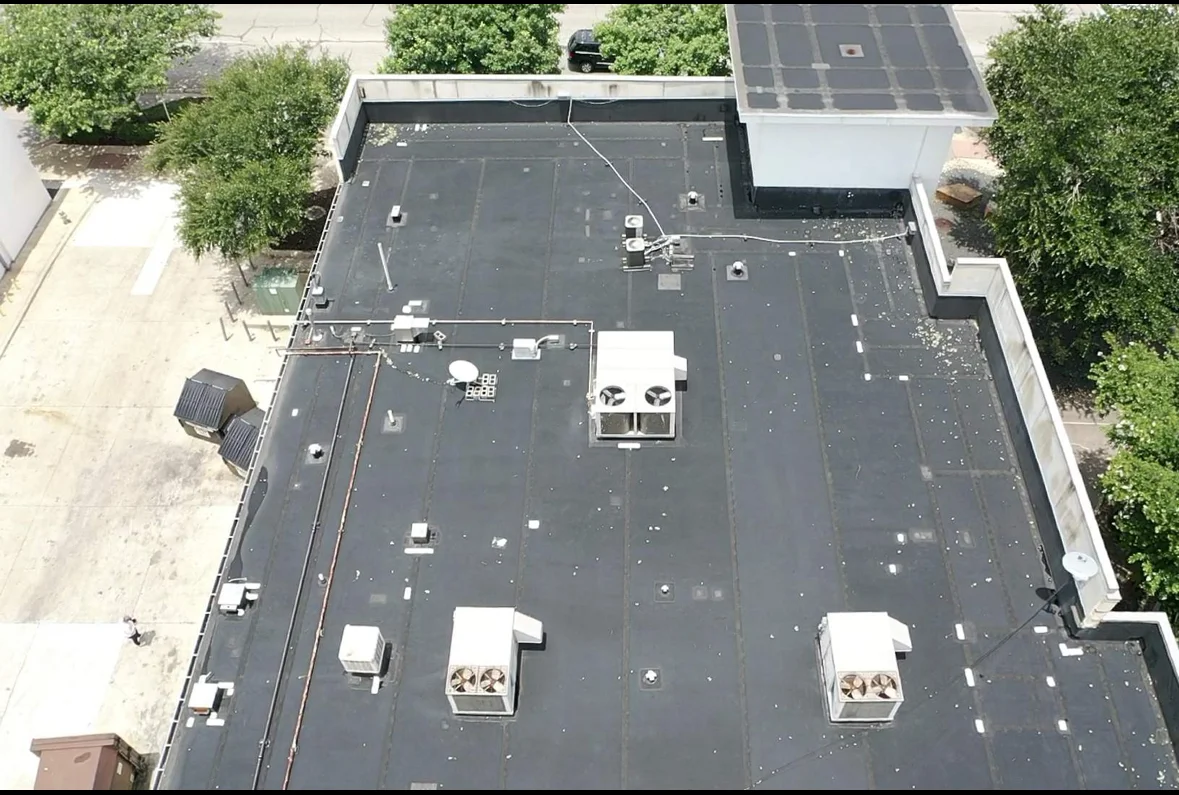
EPDM 60-mil roof systems for Birmingham industrial buildings - ballasted, mechanically attached, and fully adhered. We specialize in end-of-life 1980s-90s EPDM replacements across Jefferson County warehouse corridors. We compare the roof deck, insulation needs, slope, drainage behavior, equipment load, and expected traffic before recommending an assembly.
The 1980s–90s EPDM Replacement Cycle in Birmingham
The industrial buildings along the Norfolk Southern rail corridors east of downtown, the older warehouse stock in the Avondale and East Lake industrial zones, and the manufacturing facilities near the former U.S. Steel properties in north Jefferson County were built out heavily between 1978 and 1998. Most received ballasted EPDM roofs — loose-laid 45-mil or 60-mil membrane weighted with 10 to 12 pounds per square foot of river-wash stone. That ballast is still sitting on many of those roofs today.
When we inspect these systems, the pattern of findings is consistent: EPDM membrane that has oxidized past its design life and is brittle at seams and flashings; ballast redistributed by years of wind and foot traffic, leaving some areas thin and others heaped at drains; drain outlets partially buried under shifted stone; and parapet flashings that have separated from the termination bar and are admitting wind-driven water during gulf-system rain events. The honest assessment on most of these systems is full replacement — the membrane cannot be reliably patched across its affected area, and recovering wet or degraded ballasted EPDM produces a warranty most manufacturers will not support.
EPDM Attachment Methods — Ballasted, Mechanical, Adhered
Ballasted EPDM is primarily what we remove on Birmingham legacy buildings, not what we specify for new work. The system is structurally simple — loose-laid membrane held down by stone — but the 10 to 12 psf dead load rules out most modern construction, and the stone complicates future repairs, moisture inspections, and eventual replacement in ways that add cost at every subsequent project cycle. We specify ballasted EPDM only when the engineer of record has confirmed the structural capacity and the building use makes mechanical or adhered attachment impractical.
Mechanically attached EPDM uses plates, fasteners, and battens that secure the membrane to the deck on a pattern designed against the building's wind-uplift requirement. We use this for most new EPDM installations in Birmingham where the wind-uplift calculations support it and the project is cost-sensitive. The system installs efficiently and produces a consistent attachment pattern that performs well against Jefferson County's documented tornado-track uplift exposure.
Fully adhered EPDM bonds the membrane to the substrate with contact or water-based bonding adhesive. We specify adhered systems on reroofs over existing cover board where we need the cleanest penetration and parapet details, and where the adhered bond eliminates the low-frequency flutter that mechanically attached EPDM can develop in Birmingham's wind events. Adhered systems require careful temperature management during application — below 40°F substrate temperature, the adhesive does not bond reliably.
EPDM vs TPO for Birmingham Industrial Buildings — Honest Comparison
We install both membranes and recommend based on the building. EPDM's advantages in Birmingham industrial applications: superior elongation at low temperatures, which matters during the freeze events Birmingham averages every two to four years; better resistance to petroleum-based chemical exposure common in manufacturing and distribution environments; and a proven 35-plus-year performance record on the install base we inspect daily in the county's industrial corridors. Its primary disadvantage is that black EPDM absorbs heat aggressively in Alabama's summer climate — white EPDM and fleece-back systems address this at higher installed cost but deliver IECC reflectance compliance as a byproduct.
TPO's advantages: the white membrane delivers reflectance compliance and HVAC load reduction without a supplemental coating; heat-welded seams are faster and more consistent than tape seaming; and the formulations from the past decade have resolved the early-2000s UV degradation issues that gave TPO a mixed reputation in high-humidity southern markets. We give owners a direct comparison for their specific building and let the building conditions determine the specification.
Frequently asked questions
My 1990 Jefferson County warehouse has original ballasted EPDM. Is replacement urgent?
Not necessarily urgent in an emergency sense — adequately maintained ballasted EPDM from that era can still hold water. But a 35-year-old system with no warranty, no documentation, and no remaining serviceable life from an asset management perspective creates real exposure. We do a full inspection with moisture core pulls, drain assessment, and membrane condition evaluation under the stone, then give you a written condition assessment with a recommended timeline and budget range. Most building owners in that situation find the data useful for capital planning and lender conversations.
Can EPDM be installed over an existing roof?
Yes, with the same conditions that apply to any recover: existing insulation must be dry on core pulls, the deck must be sound, and the existing system must be compatible with the new assembly. Ballasted EPDM recovers require ballast removal before the new system can go on — that is a cost and schedule item that needs to be explicitly in the project scope before contract signing. We include ballast-removal sequencing in every ballasted-recover scope we write.
Does EPDM hold up to Birmingham spring hail?
EPDM's rubber composition gives it better inherent hail resistance than rigid membranes, but large stones still cause damage. Jefferson County spring hail events have documented 2-inch-plus stones in 2020, 2022, and 2024. Our standard EPDM specification includes an HD polyiso cover board that provides meaningful impact resistance and supports FM or UL impact ratings for insurance documentation — the same cover board upgrade we specify on TPO installs for the same reason.