Food processing and cold-storage roofing in Birmingham, AL built for washdown humidity and heavy refrigeration loads. Reroofs, repairs, and audit-ready maintenance. The plan is tailored to hours of operation, occupants, deliveries, rooftop equipment, interior sensitivity, and the owner's budget horizon.
Food Plant Roofing That Handles Washdown Steam and Heavy Refrigeration Loads
Food and beverage facilities are two buildings stacked in one. Below, there is a sanitation-driven environment of constant washdown, steam, and high interior humidity. Above, there is a roof carrying some of the heaviest mechanical loads in commercial construction: refrigeration condensers, ammonia or glycol systems, blast-freezer equipment, and the makeup-air units that keep production zones breathable. We roof Birmingham's processing plants, cold-storage operations, bakeries, and beverage facilities with both realities in front of us, because ignoring either one is how these roofs fail early.
Birmingham has a deep food-and-beverage base, from the long-standing operations like Golden Enterprises and Buffalo Rock to the distribution and processing tenants packed into the industrial corridors along Finley Boulevard, Vanderbilt Road, and out toward the Oxmoor and Lakeshore industrial districts. These are working buildings that run long shifts, and the roof has to keep producing right along with them.
Interior Humidity Drives Roofs From the Inside
Sanitation washdown is relentless in a food plant, and it loads the air below the deck with warm, moisture-saturated vapor. When that vapor reaches a cool deck, it condenses, and over time it corrodes fasteners, soaks insulation, and breaks down the bond between layers. In refrigerated and freezer space the gradient is even more aggressive, with a sharp temperature difference across the assembly that pushes moisture relentlessly toward the cold side.
We design against this with a vapor-control strategy matched to each zone of the building:
- A properly placed vapor retarder over high-humidity production and washdown areas so interior moisture cannot migrate up into the roof.
- Closed-cell or moisture-resistant insulation and cover boards over cold-storage and freezer zones, where a wet board never dries and ice can form within the assembly.
- Corrosion-resistant fasteners and plates over the wettest interior spaces, because ordinary steel does not survive long above a daily steam bath.
When we tear off an old food-plant roof, the story is usually written in the insulation: dry and intact over the offices, sodden and rusted over the cook lines and coolers. That contrast is the whole problem, and it is why a one-size roof spec fails on these buildings.
Carrying the Mechanical Load
The rooftop of a processing or cold-storage plant is dense with weight. Refrigeration racks, condenser banks, evaporative coolers, exhaust hoods over kettles and fryers, and the structural dunnage that supports it all bear down on the deck continuously. We build the membrane and flashing system to live underneath that load:
- Engineered equipment supports and walkway pads that spread weight and protect the membrane from constant service traffic.
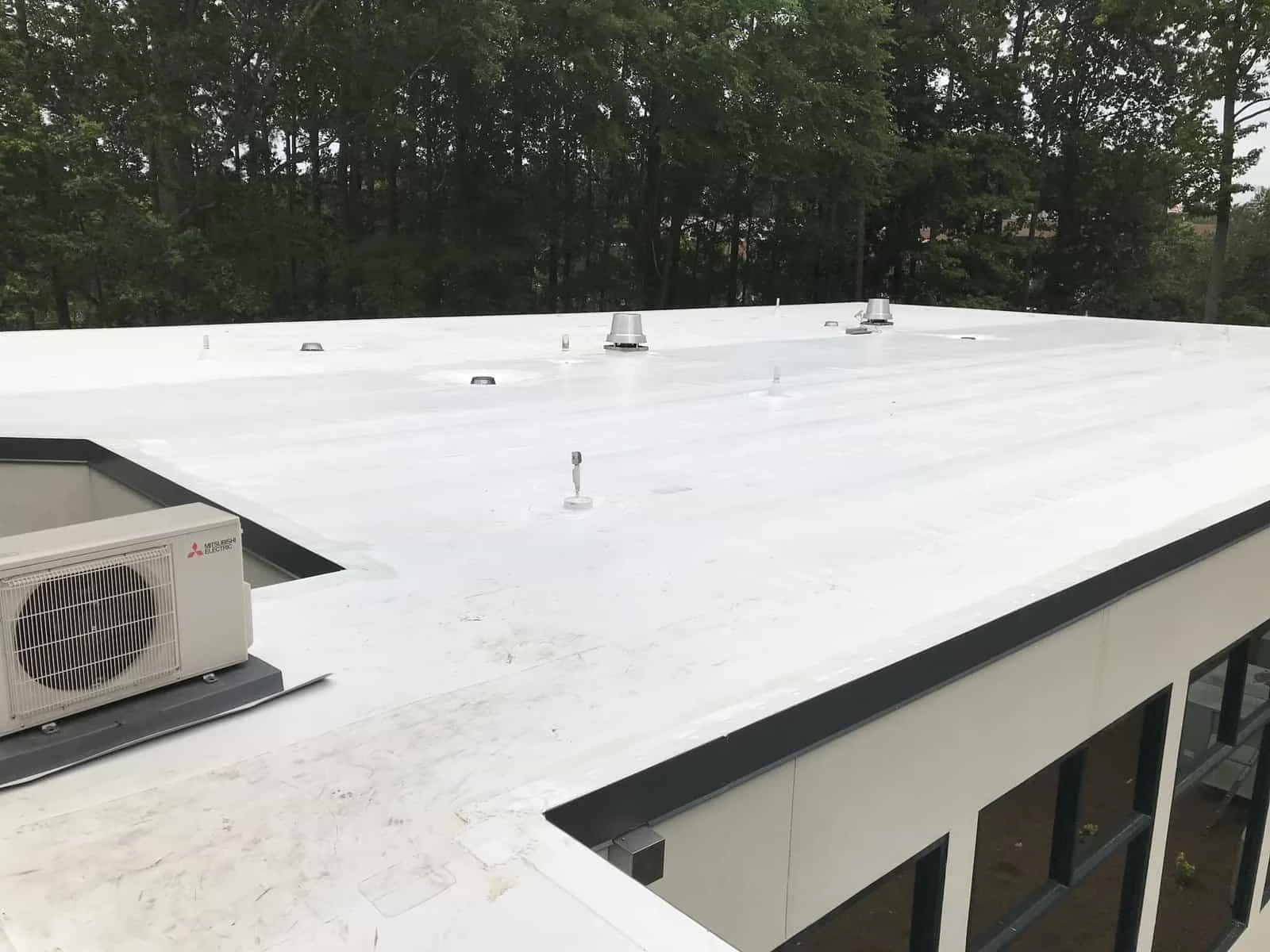
- Tall, reinforced curbs around every refrigeration and air-handling unit, detailed so vibration and condensate runoff never compromise the seal.
- Reinforced flashing at grease and exhaust discharges, where airborne grease and heat would otherwise degrade an ordinary membrane fast.
Refrigeration units also shed enormous amounts of condensate. We make sure that water is carried cleanly into the drainage system instead of being allowed to pool against a curb or run uncontrolled across the field, where it accelerates wear and breeds the standing water a food facility cannot have overhead.
Membranes Specified for the Food Environment
TPO for Reflectivity and Clean Seams
A reflective TPO with hot-air welded seams is our workhorse over most Birmingham food plants. The welded seams give a continuous surface with no adhesives for grease vapor to attack, and the bright surface cuts rooftop heat gain so the refrigeration equipment is not fighting a hot deck all summer.
PVC Where Grease and Chemicals Are Heavy
Over fryer hoods, rendering areas, and zones with heavy grease-laden exhaust, PVC is often the better long-term choice for its resistance to animal fats and chemical attack. We route it carefully around the exhaust fans where the surface takes the most punishment.
Drainage and Birmingham's Heavy Rain
Birmingham sees more than fifty inches of rain in a typical year, much of it in fast, intense bursts during spring and summer. A food-plant roof loaded with equipment has less open field to move that water, so drainage has to be deliberate. We verify drain and overflow capacity for our storm intensity, keep crickets pitched to push water around the refrigeration dunnage, and eliminate the low spots where ponding would otherwise sit against a curb. For a facility under sanitation scrutiny, standing water overhead is a liability, not just a maintenance note.
Working Around Production and Sanitation
Food production runs on a clock and under inspection, and the roof cannot become a contamination source. We sequence reroofs in dried-in sections, keep tear-off debris fully contained so nothing reaches production or sanitation zones below, and coordinate the noisiest work around your shift schedule and any audit windows. Where we work over open production, we protect the spaces underneath completely. The plant keeps running, and your sanitation standards stay intact.
Maintenance That Keeps You Out of an Auditor's Notes
On a food roof, a small breach found late becomes a sanitation finding, a product-loss event, or a refrigeration short-cycle that drives up energy cost. We set processing clients up with scheduled inspections aimed at the high-risk details: the curb flashings around refrigeration and exhaust, the condensate routing, the drains, and the seams over washdown zones. We document each visit so it slots cleanly into your facility's records, and we flag a lifting seam or tired boot in the fall before it turns into a winter drip over open product.
Serving Food and Beverage Plants Across Birmingham
We maintain and replace roofs for processors, bakeries, beverage operations, and cold-storage facilities throughout Jefferson and Shelby counties — the industrial districts north of downtown, the corridors around Oxmoor and Lakeshore, and the distribution-heavy zones near the interstate junctions. Whatever you produce and however you keep it cold, we build the roof to survive both the steam below and the equipment above.
Get a Read on Your Plant's Roof
If you are seeing condensation drips over the cook line, rust on fasteners above the coolers, or membrane that looks beaten around the refrigeration racks, those are the warning signs of a food-plant roof aging from both directions. Contact us and we will survey the assembly for trapped moisture, check the equipment curbs and drainage, and give you a clear plan to keep water out without disrupting production.