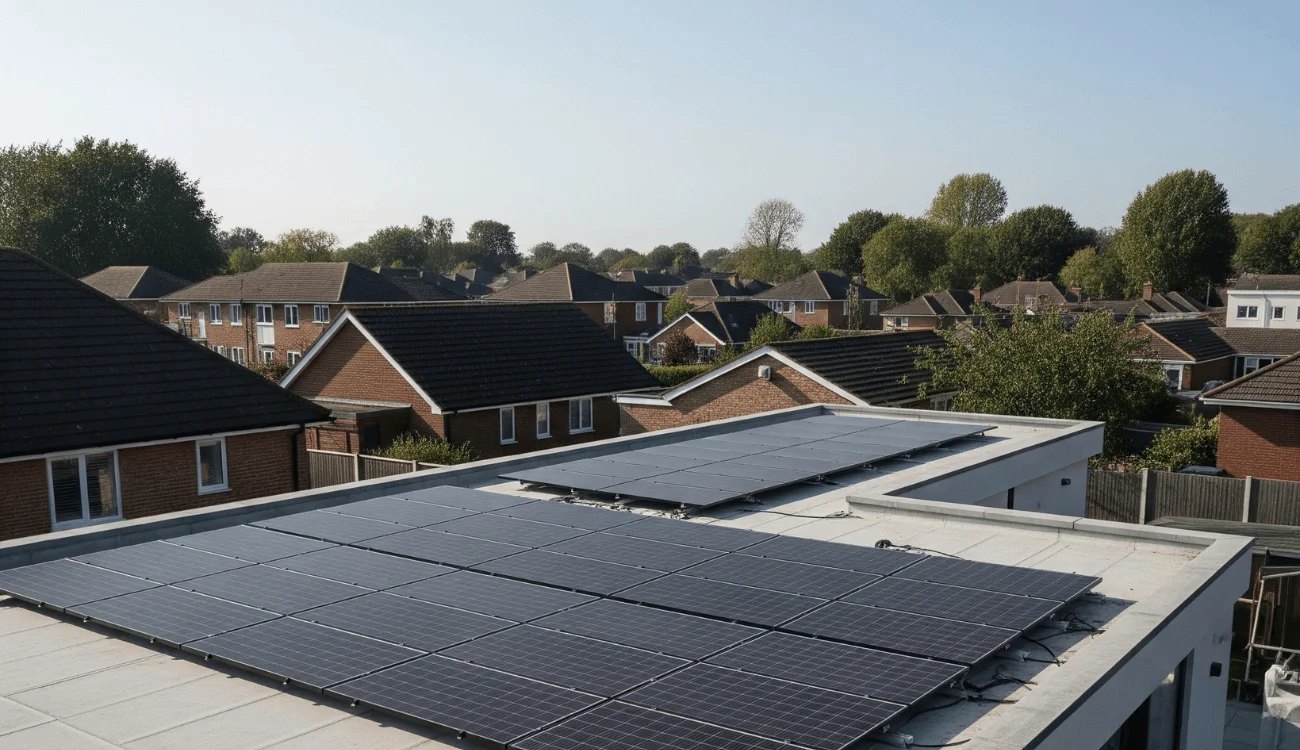
Commercial solar roof integration in Birmingham, AL. We coordinate PV racking penetrations, membrane compatibility, weight and uplift, and manufacturer warranties so your roof stays dry under the array. The work is planned around roof access, active building use, drainage, membrane condition, and the owner's timeline for repair, maintenance, or capital work.
Commercial Solar Roof Integration for Birmingham Properties
Putting a photovoltaic array on a low-slope commercial roof is a roofing decision before it is an energy decision, and that order matters more than most building owners expect. We work with property managers and facility teams across Birmingham to make sure the roof under a solar system is ready to carry the racking, the foot traffic, and the decades of service the panels are supposed to deliver. When the roof and the array are planned together, you get clean energy and a watertight membrane. When they are planned separately, you get callbacks, leaks, and a finger-pointing match between two contractors. Our job is to keep that from happening.
Demand for rooftop solar has grown quickly along the U.S. 280 corridor, in the office parks off Lakeshore Parkway, and across the warehouse and distribution buildings in the Oxmoor Valley and out toward Pelham along I-65. Tenants in these buildings are watching utility costs, and large flat roofs are an obvious place to mount generation. We help owners in these areas evaluate whether the existing membrane and structure can host an array without compromising the roof warranty or the building envelope.
Why the Roof Has to Come First
A photovoltaic system is a multi-decade commitment, and so is the roof beneath it. The trouble is that panels typically outlast the membrane they sit on if the membrane was already aging at installation. If your roof has eight years of service life left and you mount a twenty-five-year array on top of it, you are buying an expensive removal and reinstallation cycle in the middle of the panels' useful life. Before any racking goes down, we assess the remaining life of the existing system, the condition of the insulation and deck, and whether a recover or replacement should happen first.
This is the single most common conversation we have with Birmingham owners considering solar. It is far cheaper to replace or recover a tired roof before the array is installed than to detach, stack, and reset hundreds of panels later. We would rather have that conversation honestly up front than watch a client pay twice.
Membrane Compatibility and the Array Above It
Not every roof membrane behaves the same way under a solar field. TPO and PVC single-ply systems are common choices under arrays because their reflective surfaces can actually help panel efficiency by keeping rooftop temperatures down, and they handle the partial shading and trapped heat that a dense array creates. EPDM, modified bitumen, and older built-up roofs each carry their own considerations for ballast load, traffic, and heat. We evaluate the specific membrane on your building and confirm that the racking method, the walk pads, and any flashing details are compatible with that system rather than assuming a one-size approach.
Reflective single-ply has become especially popular on the newer distribution buildings around Birmingham-Shuttlesworth International Airport and the logistics space along the Highway 31 and I-65 spine, where owners want both the energy production and the cooling benefit of a light-colored roof.
Penetrations, Racking, and Keeping the Roof Dry
The core roofing risk in any solar project is penetration. Mechanically attached racking requires the array to be bolted through the membrane and into the deck or structure, and every one of those attachment points is a potential leak path. There can be hundreds of them across a single roof. Each penetration has to be flashed correctly, sealed with compatible materials, and detailed so that water sheds away rather than pooling at the base of a stanchion. Sloppy flashing at racking feet is the most frequent source of post-solar leaks we are called to repair.
Ballasted racking avoids penetrations by holding the array down with weight rather than fasteners, which protects the membrane but adds significant dead load and depends entirely on the roof being able to carry it. We help owners weigh the two approaches against the structure they actually have. On many older Birmingham buildings the structural capacity, not the roofing, is the deciding factor.
Weight and Wind Uplift
Adding a solar array changes the loads a roof has to manage in two directions. There is the static dead load of the panels and racking pressing down, which matters most for ballasted systems, and there is wind uplift trying to lift the array off the building. Birmingham sits in a part of the Southeast that sees strong straight-line winds and severe spring storms, and an array that is not engineered and anchored for local wind speeds becomes a liability in the first real weather event. We coordinate so that the attachment or ballast design accounts for the uplift forces the roof will actually face here, including the higher pressures at roof edges and corners where wind effects concentrate.
- Confirm the structure can carry panel and racking dead load, especially for ballasted designs
- Verify attachment density and ballast against local wind uplift requirements
- Pay special attention to perimeter and corner zones where uplift pressures are highest
- Make sure added loads do not crush insulation or deform the deck over time
Coordinating the Roofer and the Solar Installer
The biggest preventable problem in commercial solar is the gap between the roofing contractor and the solar installer. These are usually two different companies, and when something leaks afterward, each tends to blame the other. We close that gap by being involved before the array is designed. We define how the racking attaches, who flashes each penetration, what materials are compatible with the existing membrane, and how the two scopes hand off to each other on the roof.
Just as important is the warranty question. Most membrane manufacturers will void or limit a roof warranty if a third party penetrates or modifies the roof without following approved details. We coordinate with the manufacturer so the solar attachments are installed to specifications that keep your existing warranty intact, and we document the work so coverage holds. For Birmingham owners with newer roofs still under warranty, protecting that coverage is often worth more than the energy savings in the early years.
Documentation That Holds Up
When the array is finished, we make sure there is a clear record of every penetration, every flashing detail, and every manufacturer approval. That documentation matters when a tenant turns over, when the building sells, or when a leak appears years later and someone needs to know exactly what is under the panels. Owners managing multiple buildings across Jefferson County tell us this paper trail is one of the most valuable parts of the job, because it removes the guesswork the next time anyone goes up on the roof.
Inspection and Maintenance Once the Panels Are Live
A solar array makes routine roof maintenance harder, not easier. Panels cover much of the membrane, foot traffic increases as crews service the inverters and wiring, and leaks can travel a long way under the array before they show up inside the building. We set up access paths and walk pads during installation so the roof can still be inspected and serviced without anyone stepping where they should not. After the system is live, we recommend scheduled inspections that check the flashing at racking feet, the condition of the membrane in the shaded areas between rows, and any debris collecting under the panels that traps moisture.
For properties around Riverchase, the Lakeshore office corridor, and the industrial parks off Oxmoor Road, where arrays are becoming common, this kind of structured maintenance is what protects both the roof investment and the energy investment over the long run.
Talk to Us Before You Sign a Solar Contract
If your Birmingham building is being evaluated for rooftop solar, bring us in before the array is designed rather than after. We will assess the roof's remaining life, confirm membrane and structural compatibility, plan the penetration and flashing details, and coordinate with your solar installer and the membrane manufacturer so the warranty survives. A solar project done in the right order produces clean power and a roof that stays dry for decades. Done in the wrong order, it produces leaks and a removal bill nobody budgeted for. We are here to make sure it is the former.