Ballasted single-ply roof systems on older Birmingham commercial buildings - why we rarely specify new ballasted systems, and how we sequence ballast removal during reroofs across Jefferson County to control cost and schedule. We compare the roof deck, insulation needs, slope, drainage behavior, equipment load, and expected traffic before recommending an assembly.
Why We Rarely Specify Ballasted Systems on New Birmingham Work
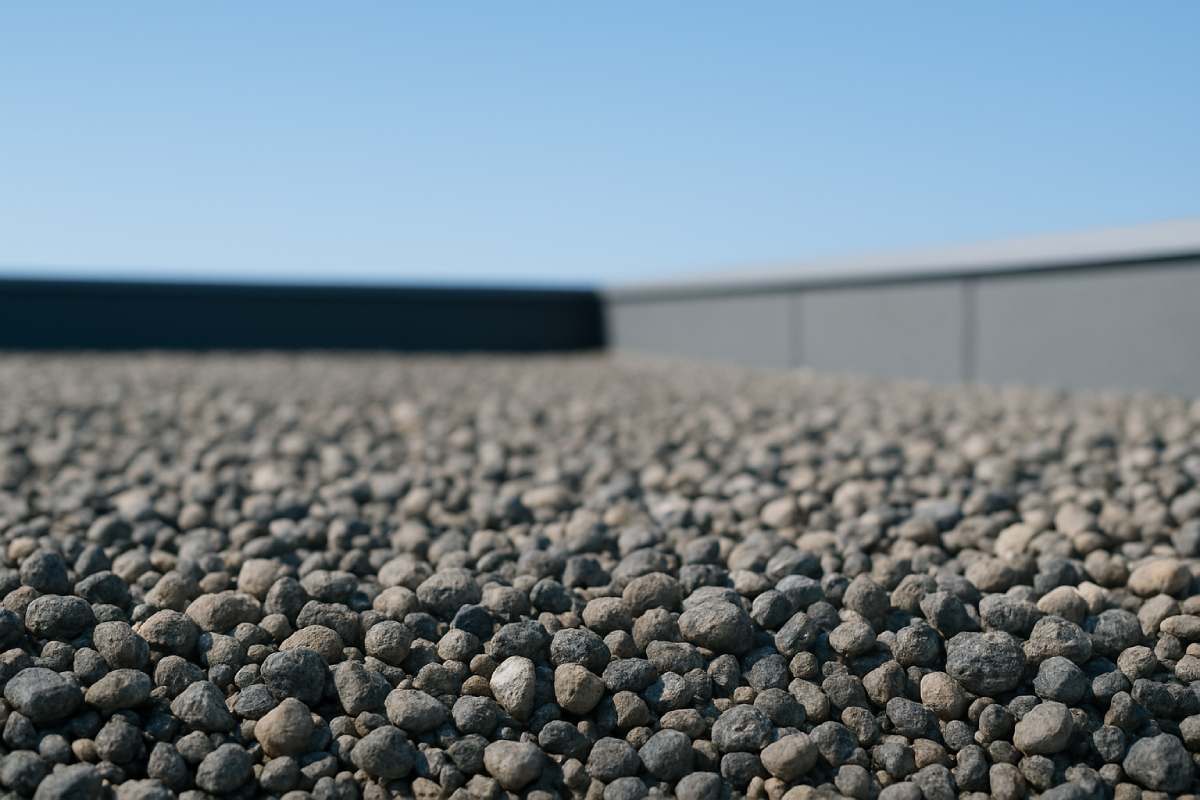
Ballasted single-ply made practical sense in an era of generous structural margins and low labor costs. Modern Birmingham commercial construction is engineered closer to structural minimums, and the 10 to 12 psf dead load of a ballasted system frequently cannot be accommodated without structural engineering review and often structural uprating — a cost that removes ballasted systems from most new-construction specifications before the membrane conversation even starts.
The future-cost argument compounds the structural one. A building owner who installs ballasted roofing today is committing their successors to ballast-removal cost at the next reroof cycle, which arrives in 20 to 30 years. The stone must come off at that reroof — it cannot be left in place under a new system without voiding the new warranty and potentially creating unsafe concentrated loads. That future obligation is real and quantifiable, and we include it in lifecycle cost comparisons when an owner asks whether ballasted is worth considering on a new application.
Ballast Removal Sequencing During Birmingham Reroofs
Ballast removal on a Birmingham commercial reroof is a distinct production phase before membrane work can begin. The sequence we follow: mark drain locations before ballast is disturbed, establish material staging — typically a waste container at the building perimeter or on a loading dock — remove ballast in 5,000 to 10,000 square foot sections keeping pace with the membrane removal and dry-in crew, transport stone to the staging area, and dispose of or segregate for reuse. Summer ballast removal in Birmingham requires early-morning scheduling to manage heat exposure for the removal crew.
The labor cost for ballast removal typically runs $0.25 to $0.40 per pound of stone, or roughly $2.50 to $4.80 per square foot of roof area. On a 100,000 square foot building with 1.2 million pounds of stone, that is $300,000 to $576,000 in removal cost alone, before any membrane or insulation work. Building owners who receive a scope without an explicit ballast-removal line item should require clarification on how the contractor is handling it — underscoped ballast removal is one of the most common change-order sources on Birmingham commercial reroof projects.
Current Condition Assessment for Birmingham Ballasted Roofs
You cannot meaningfully evaluate a ballasted roof from the surface — the membrane is hidden under 4 to 6 inches of stone. We pull ballast from 8 to 10 locations distributed across the roof, expose the membrane, and inspect seam condition and membrane flexibility. Brittleness at seams and flashings indicates that UV degradation has progressed beyond the membrane's protective design life, even though the stone shielded the field area from direct UV exposure.
Moisture cores on ballasted systems require moving the ballast, penetrating the membrane, and pulling the insulation sample below. Wet insulation under ballasted systems is a common finding on Birmingham roofs in the 30 to 40-year age range: stone accumulates debris and vegetative matter at drain locations over decades, the drains restrict, and water sits on the membrane surface through Birmingham's frequent rain events rather than draining within hours. By the time interior damage becomes visible, the insulation may have been holding moisture for years. This pattern is an argument for periodic targeted inspection on aging ballasted roofs — not just waiting for visible interior damage as the first signal.
Frequently asked questions
My 1989 Jefferson County warehouse has original ballasted EPDM. Can it be recovered or does it need full replacement?
We need to examine the membrane under the stone to answer that honestly. We pull ballast from representative locations, inspect the membrane and seams, and core-pull the insulation below. If the membrane is still flexible and the insulation is dry, a mechanically attached TPO or EPDM recover over the existing system — after stone removal — can be viable for another 15 to 20 years at roughly half the capital cost of full replacement. If the membrane is brittle, seams are delaminated, or insulation reads wet in more than 25% of cores, replacement is the honest scope. The ballast removal cost is the same either way — it comes off first regardless of which direction the scope goes.
How long does ballast removal add to a Birmingham commercial reroof schedule?
For a typical 50,000 to 100,000 square foot Birmingham industrial building, ballast removal adds 3 to 5 days to the project schedule before membrane work begins. Restricted jobsite access — single-lane service drives, urban sites in the Avondale or north Birmingham industrial corridors with limited staging area — can extend this further. We produce a detailed production schedule that includes the ballast-removal phase before contract signing so the facility team can plan around it.
Can the ballast stone be reused or recycled?
River-wash ballast stone is inert and can be reused for site landscaping, drainage fill, or aggregate applications. Building owners who want to reuse it need to plan for a staging area on-site during production. If the stone is going to waste, Alabama aggregate and concrete recyclers typically accept clean river stone. Coal-contaminated stone from roofs adjacent to coal-tar BUR systems requires verification before recycling. We stage stone separately from other roof debris so the reuse option stays open.