Built-up roofing installation, maintenance, and assessment for Birmingham commercial buildings - multi-ply asphalt systems on older downtown and industrial inventory with proper recover and tear-off scoping. The work is planned around roof access, active building use, drainage, membrane condition, and the owner's timeline for repair, maintenance, or capital work.
BUR System Components and Installation
A built-up roof system consists of alternating layers of bitumen — hot-applied asphalt or coal-tar pitch — and reinforcing felts, installed in multiple plies over a base sheet on the roof deck. The number of plies determines the system's redundancy and its warranty term: three-ply systems are standard for most commercial applications; four-ply systems are specified for heavy-traffic environments, chemical exposure, or where the building owner wants the additional warranty depth. We install three-ply and four-ply BUR systems with Type III or Type IV asphalt to Alabama climate requirements.
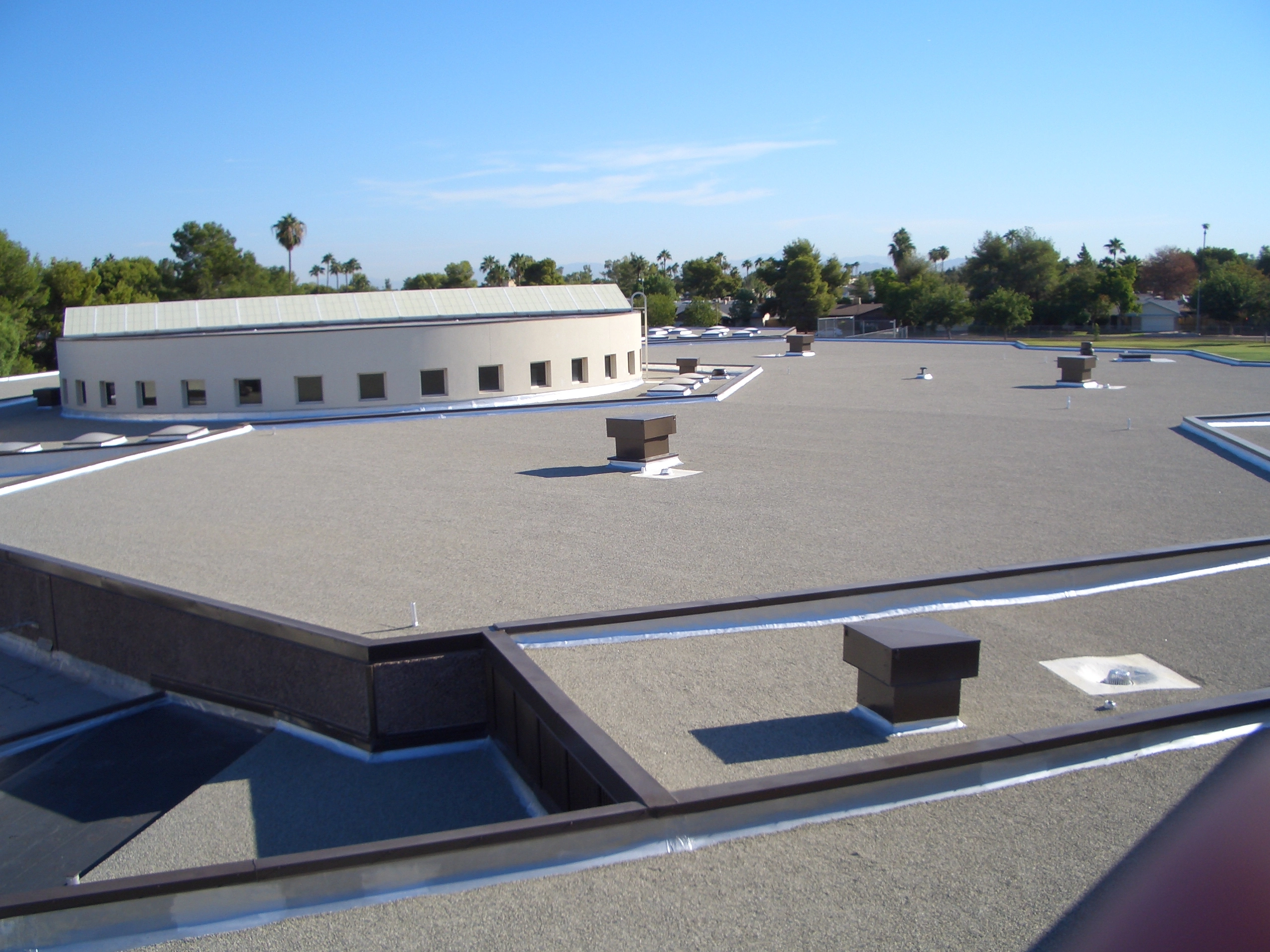
Aggregate surfacing — gravel or slag ballast embedded in a flood coat of hot asphalt — is the traditional BUR finish. Aggregate protects the underlying plies from UV degradation, provides fire resistance, and adds thermal mass. The trade-off is weight — aggregate-surfaced BUR typically runs 12 to 16 pounds per square foot, which is a structural consideration on older Birmingham commercial buildings that were not designed for additional dead load. We verify structural capacity before specifying aggregate surfacing on any building where the deck or framing age raises questions.
Smooth-surfaced BUR with a reflective coating finish is the alternative. Lower weight, easier to inspect, and the reflective coating reduces surface temperatures — meaningful in Birmingham's summer heat envelope. Smooth-surfaced BUR requires more frequent inspection because the plies are not protected by aggregate, but it is the correct specification for buildings where structural capacity is the limiting factor.
Maintaining Existing BUR on Birmingham's Older Inventory
BUR maintenance on the older Birmingham commercial stock means something specific: we walk the roof, probe for delaminated plies using a core-cut in suspected wet or soft areas, document all blisters and alligatoring, pull drain inserts and clear gravel from drains, and photograph every flashing transition. The most common failure mode on older Birmingham BUR is flashing failure at parapets and penetrations — the original bitumen flashing has hardened, cracked under freeze-thaw cycling, and is admitting water at the wall base.
For BUR systems that pass the core-cut test — dry insulation under intact plies — we can extend service life with a flood coat of asphalt and new aggregate in areas where the existing aggregate has been displaced or embedded too deep to provide protection, plus new bitumen flashing at all failed parapet and penetration transitions. This is a cost-effective bridge between the current state and a planned replacement on the owner's capital schedule.
Birmingham's winter ice events accelerate BUR flashing failure more than any other climate factor. The February 2021 ice storm, which held below-freezing temperatures for nearly a week, cracked hardened bitumen flashing details on dozens of older commercial buildings across Jefferson County. Our BUR maintenance inspections include a freeze-thaw vulnerability assessment: we flag every flashing detail that is within two to three years of failure under sustained cold, so the owner can plan targeted repair before the next ice season, not after the ceiling tiles are wet.
BUR End-of-Life — Recover vs. Tear-Off
Recovering an existing BUR system with a new single-ply membrane or modified bitumen cap sheet is sometimes the right call — when the BUR plies are sound, the insulation is dry, and the deck is in good condition, a recover adds 15 to 20 years of service life at roughly half the cost of full tear-off and replacement. The Birmingham building inventory that benefits most from this approach is the mid-1980s suburban commercial buildout along US-280 and I-65 in Hoover and Vestavia Hills — buildings with three-ply BUR that was maintained adequately and is now approaching its warranty limit with intact substrates.
Tear-off is required when moisture cores show wet insulation, when ply delamination is widespread, or when the deck below has deteriorated. Recovering over wet insulation traps moisture against the new membrane and voids the new warranty — we will not write a recover scope over a BUR system with saturated insulation regardless of the owner's preference for the lower first cost.
We scope every BUR end-of-life decision with a written moisture core report — minimum five core locations per 10,000 square feet of roof — and a written recover-vs-replace recommendation with the cost differential and projected service life for both options. That document is what the building owner needs to make the capital decision with defensible facts, not a contractor's estimate that is optimized for the work the contractor prefers to do.
Frequently asked questions
Is built-up roofing still installed on new Birmingham commercial buildings?
Yes, though it is less common than TPO or EPDM for most new commercial construction. BUR is specified on buildings that need heavy foot traffic tolerance, chemical resistance, or where the building owner has a specific preference for the redundant ply system. We install new BUR on appropriate Birmingham commercial projects — industrial buildings near BHM airport, chemical storage and processing facilities, and specialized institutional buildings where the multi-ply redundancy justifies the additional installation cost.
How do I know if my existing Birmingham BUR roof can be recovered or needs replacement?
Moisture core testing is the only reliable answer. We pull cores in a grid pattern — minimum five locations per 10,000 sq ft — and cut them open to assess insulation moisture content. If insulation is dry, ply adhesion is intact, and the deck shows no deterioration, a recover is on the table. If cores show wet insulation or delaminated plies, tear-off is the correct scope. We deliver the core results in a written report with photographs — not a verbal recommendation on the job site.
How does Birmingham's spring hail season affect BUR?
Aggregate-surfaced BUR handles hail better than single-ply membranes — the aggregate dissipates impact energy across multiple plies rather than concentrating it at a single membrane layer. However, hail impact can displace or fracture aggregate and crack hardened bitumen flashings at penetrations. After any Jefferson County hail event of 1.5 inches or larger, we recommend a post-storm inspection to document flashing and aggregate condition before water intrusion develops.
What does BUR tear-off and replacement cost compared to TPO on a Birmingham building?
BUR tear-off typically runs higher than TPO tear-off because of the weight and adhesion of the multi-ply system — more labor to remove, heavier loads to haul. New BUR installation cost is also higher than TPO on a per-square basis. The lifecycle comparison depends on the specific building and capital horizon. We produce detailed scope comparisons — BUR versus TPO versus modified bitumen — for any Birmingham building where the system choice is not predetermined by the existing deck or structural constraints.