PVC commercial roofing for Birmingham restaurants, kitchen exhaust environments, chemical-exposure buildings, and commercial flat roofs requiring superior chemical and grease resistance - 50-mil and 60-mil systems with 20-year manufacturer warranty options. The work is planned around roof access, active building use, drainage, membrane condition, and the owner's timeline for repair, maintenance, or capital work.
Where PVC Is the Right Specification
Restaurant and food service buildings: Kitchen exhaust systems vent grease-laden air through roof penetrations — and in many restaurant configurations, this grease deposits on the adjacent membrane surface over time. Animal and vegetable oils attack TPO and EPDM membranes, causing surface degradation and premature failure in the grease-deposit zone. PVC is resistant to these oils and maintains its integrity in kitchen exhaust exposure. Every restaurant roof we inspect gets evaluated for exhaust deposit patterns before we specify a membrane.
Chemical storage and industrial buildings: Buildings with chemical storage, industrial process exhaust, or laboratories that vent chemical vapors through the roof need a membrane that resists the relevant chemical profile. PVC has broad chemical resistance — petroleum distillates, alcohols, many industrial solvents. For buildings in Birmingham's industrial and manufacturing corridors, including facilities in the East Birmingham rail corridor and the BHM airport-adjacent industrial parks, PVC's chemical resistance profile makes it the correct specification over TPO.
Roofs requiring maximum reflectivity: White PVC has the highest solar reflectivity of the three major single-ply membranes. For Birmingham buildings where the energy performance modeling shows significant cooling load reduction from a highly reflective white membrane — particularly in 5 Points South and Lakeview commercial buildings with high glass-to-floor ratios and high cooling loads — white PVC can outperform white TPO on reflectivity metrics.
Buildings requiring a custom-fit membrane: Duro-Last manufactures custom-fabricated PVC membrane systems — the membrane is pre-cut and factory-welded to the building's specific geometry, with field welding limited to splice connections. For buildings with complex roof geometry, many penetrations, and long perimeter-to-field ratios (common on older Birmingham warehouse conversions in Avondale), a custom-fabricated PVC system can reduce field-weld quantity and associated seam-failure risk.
PVC Installation in Birmingham's Climate
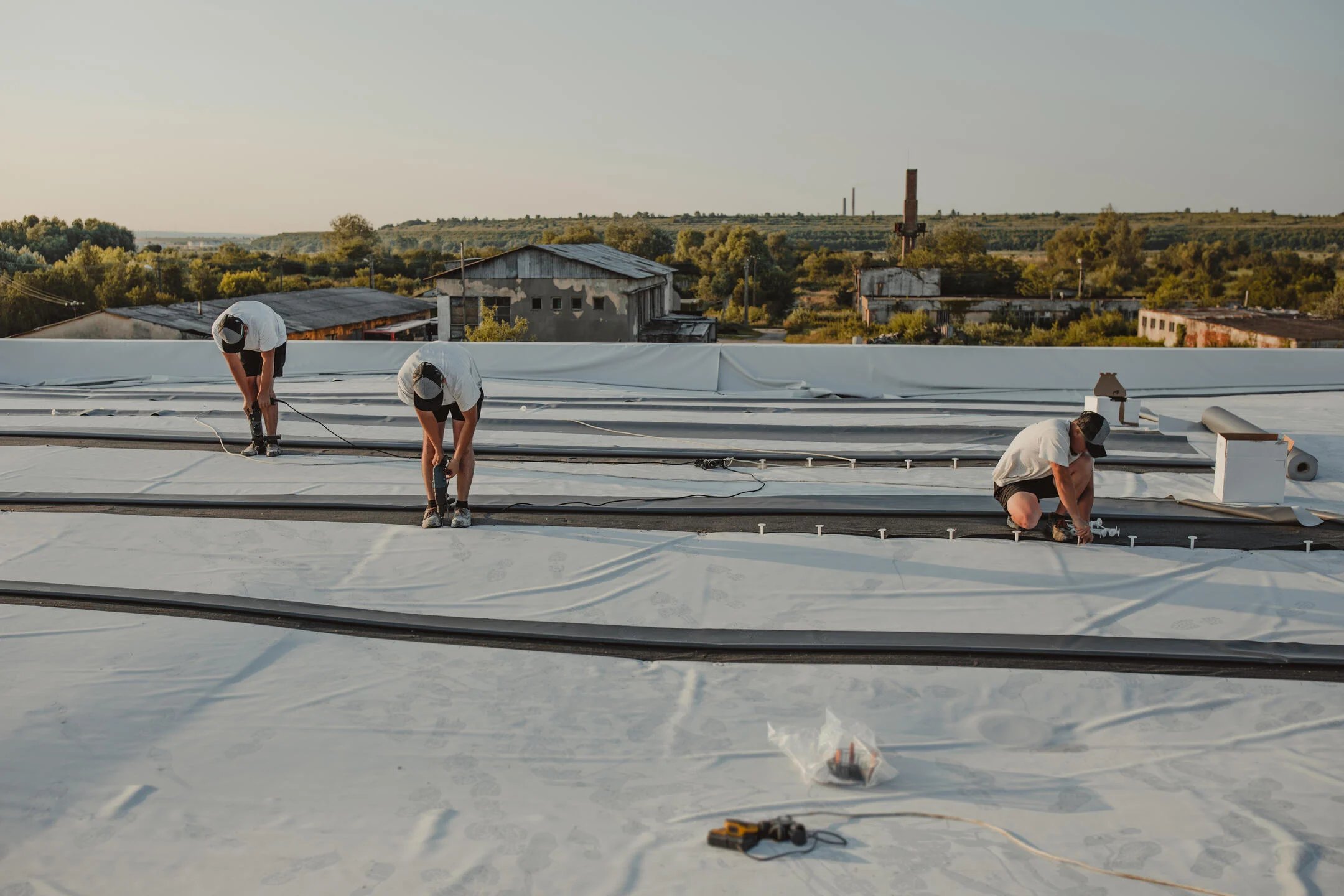
PVC is installed mechanically attached or fully adhered — the same attachment methods as TPO. Ballasted PVC is rare in Birmingham commercial work due to structural load constraints. Mechanically attached PVC on mechanically fastened insulation over metal deck is the standard for most Birmingham industrial and warehouse applications. Fully adhered PVC is used for buildings requiring the cleanest finish or for complex geometry where mechanical attachment is difficult.
Cold-temperature installation: PVC becomes stiffer at low temperatures, which creates field-weld challenges in Birmingham's November through February window. We plan PVC installation projects to avoid cold-temperature weld windows when possible, or we use manufacturer-approved cold-temperature welding procedures when the project schedule requires winter installation. PVC welded below 40°F ambient without cold-temperature procedures produces inconsistent seam quality.
Seam testing: All PVC seams are probe-tested at 100 percent of seam length before closeout. This is the same standard we apply to TPO. We do not accept visual-only seam QC on any heat-welded membrane.
PVC vs. TPO — When to Choose Which
The decision between PVC and TPO for a Birmingham commercial building comes down to building use, chemical exposure, and budget. TPO is less expensive per square, has a wider manufacturer selection, and is the better choice for standard office, retail, and warehouse buildings with no chemical or grease exposure. PVC is the correct choice when grease or chemical resistance is a genuine operational requirement, when maximum reflectivity is a design criterion, or when a custom-fabricated system is appropriate for the building's geometry.
Both carry 20-year manufacturer NDL warranties. Both are heat-welded. Both are mechanically attached or fully adhered. The functional performance in normal commercial building use is equivalent — the differentiation is in the specific applications where PVC's material properties outperform TPO.
Frequently asked questions
Why is PVC recommended for restaurant roofs in Birmingham?
Restaurant exhaust systems vent grease-laden air through roof penetrations. Over time, grease deposits on the adjacent membrane. Animal and vegetable oils accelerate degradation in TPO and EPDM membranes — the oils migrate into the polymer matrix and cause premature surface degradation in the exhaust deposit zone. PVC is resistant to these oils and maintains its integrity in kitchen exhaust environments. For restaurant buildings in the 5 Points South dining district, the Lakeview restaurant corridor, and the Hoover Galleria food operations, PVC is the appropriate specification.
How long does PVC roofing last in Birmingham?
Modern PVC formulations from Sika Sarnafil, Duro-Last, and Firestone carry 20-year manufacturer NDL warranties and are engineered to perform through the warranty term in Birmingham's UV and temperature environment. The plasticizer migration issues in older PVC formulations have been addressed in current products. Properly maintained PVC systems with documented biannual inspection routinely perform through and beyond the 20-year warranty term.
Is PVC more expensive than TPO?
Yes. PVC membrane costs more per square than TPO membrane, and the material cost difference flows through to the installed-cost-per-square. For standard commercial buildings without chemical or grease exposure, TPO is the more cost-effective specification. For buildings where PVC's material properties are a functional requirement — restaurant exhaust exposure, chemical resistance, or custom-fabricated geometry — the additional cost is justified by the performance difference.