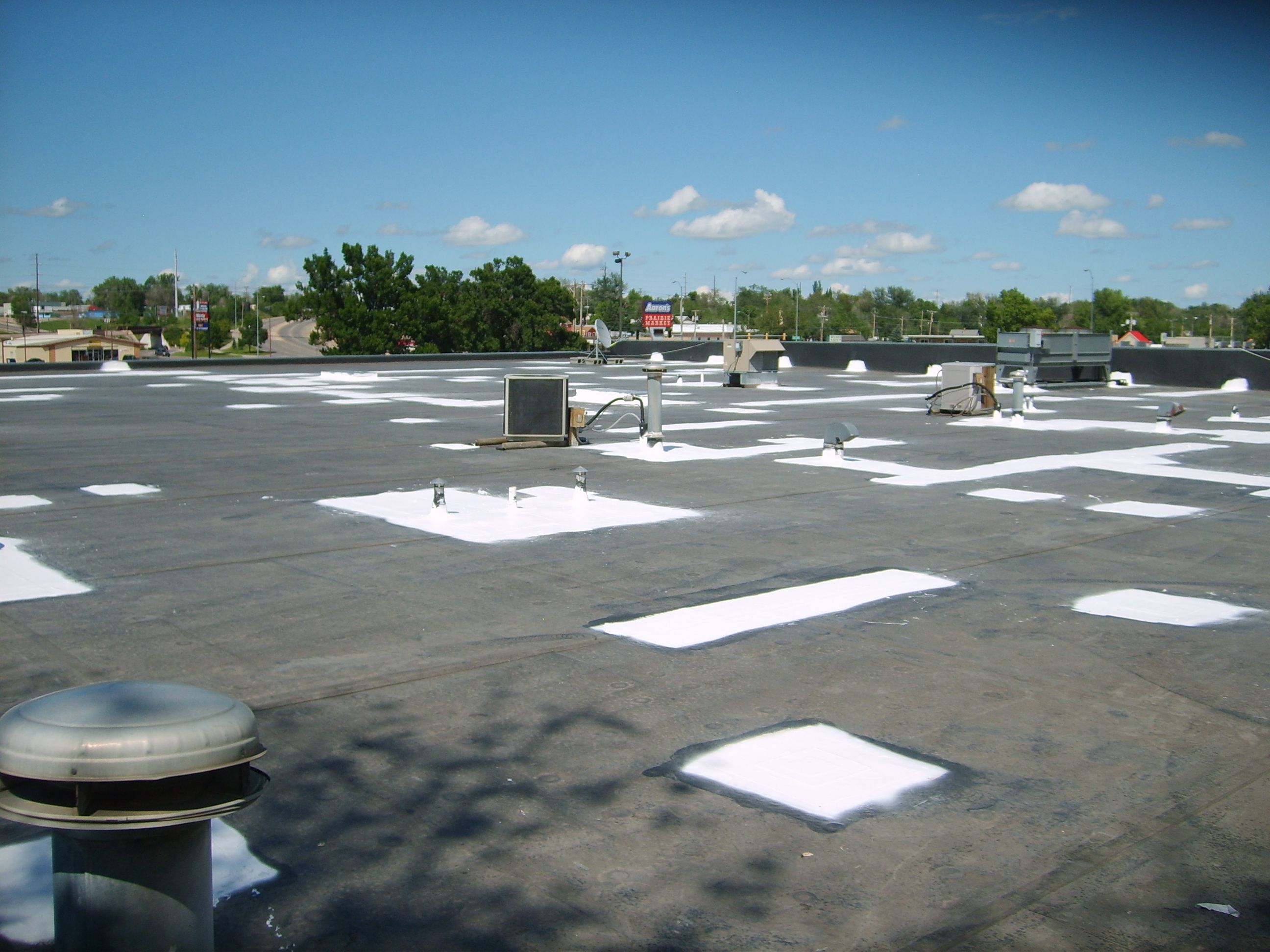
EPDM commercial roofing installation, repair, and recover for Birmingham and Jefferson County buildings - 60-mil and 90-mil rubber membrane systems with 20-year manufacturer warranty paths on industrial, warehouse, and low-slope commercial applications. The work is planned around roof access, active building use, drainage, membrane condition, and the owner's timeline for repair, maintenance, or capital work.
EPDM Membrane Thickness — 60-mil vs 90-mil
60-mil EPDM is the standard commercial specification for most Birmingham warehouse, distribution, and industrial buildings — adequate for normal mechanical traffic, handles Jefferson County's freeze-thaw cycles, and carries a 20-year manufacturer NDL warranty. This is the correct spec for the majority of the commercial and industrial inventory in the Trussville, Moody, and Center Point industrial corridors.
90-mil EPDM is the heavy-duty specification for buildings with high mechanical foot traffic, rooftop equipment that requires frequent service access, or buildings where the membrane will be subject to physical abuse from industrial operations. The Mercedes manufacturing support facilities in the Vance area and the heavy industrial facilities in the East Birmingham rail corridor are typical 90-mil applications. The additional thickness provides significantly better puncture resistance and handles concentrated load from equipment drops and maintenance tools.
Attachment Methods and Seaming
Mechanically attached: Membrane fastened at the perimeter and field laps with fasteners and plates into the deck. Standard for most Birmingham commercial and industrial EPDM work. Fastener pattern is designed against Alabama wind-uplift requirements — and for Jefferson County buildings in tornado-track corridors, against the conservative exposure documented by the April 2011 superoutbreak.
Fully adhered: Membrane bonded to the substrate with EPDM-specific bonding adhesive. More expensive and more sensitive to temperature and humidity during installation. Used for buildings where the aesthetic requires a flat, uninterrupted membrane surface, or for buildings with complex geometry where mechanical attachment at required pattern density is difficult. EPDM fully adhered installations require controlled temperature — we do not adhere below 40°F ambient, which matters in Birmingham's November through February window.
Seaming method: All EPDM field seams are lapped and sealed with EPDM seam tape and seam adhesive. No heat welding — EPDM is a thermoset membrane and cannot be heat-welded. This distinguishes it from TPO and PVC (thermoplastic membranes) and means seam quality depends on adhesive application technique and cure conditions. Our crews are trained to the manufacturer's adhesive application standard. All seams are probe-tested before closeout.
EPDM Performance in Birmingham's Climate
Freeze-thaw performance: EPDM's primary competitive advantage over TPO in Birmingham's climate is its low-temperature flexibility. EPDM remains flexible and elastic at temperatures well below freezing, which means it does not crack at parapet flashings and pipe boots during Birmingham's winter ice events the way that rigid thermoplastic flashings can. For buildings in Mountain Brook and Vestavia Hills where the winter temperature range is more pronounced than the urban core, EPDM's low-temperature behavior is a meaningful selection factor.
UV and heat performance: Modern EPDM formulations handle Birmingham's summer UV load and surface temperatures (regularly above 150°F on dark membranes) without the surface chalk and brittleness that characterized 1980s-era formulations. Carbon black in the membrane formula provides UV stabilization. White-membrane EPDM is available for buildings seeking cool-roof reflectivity, though white EPDM does not reflect as effectively as white TPO.
Hail resistance: EPDM is generally more resistant to hail impact than TPO membrane because its thermoset composition is more elastic under concentrated impact — it deforms under impact rather than cracking. HD polyiso or HD gypsum cover board under EPDM provides additional impact resistance for the Jefferson County spring hail corridor. We specify HD cover board on all Jefferson County EPDM installations and document the cover board specification at closeout.
Frequently asked questions
How do EPDM seams compare to TPO seams in reliability?
This is a legitimate question. TPO seams are heat-welded and, when done correctly, form a monolithic bond that is essentially as strong as the membrane itself. EPDM seams rely on adhesive tape and bonding adhesive — a chemical bond that is somewhat dependent on surface preparation and application conditions. Modern EPDM seam adhesives and tapes have improved substantially over the original formulations. Properly installed EPDM seams perform through the warranty term. The key is surface preparation and adhesive application per the manufacturer's spec — which we follow.
Can EPDM be repaired when it tears or punctures?
Yes. EPDM punctures and tears are repaired with EPDM patch tape or a compatible patch membrane bonded with seam adhesive. The repair is reliable when the membrane surface is clean, the patch extends at least six inches beyond the damage in all directions, and the adhesive is applied and cured at manufacturer-specified conditions. We carry EPDM patch materials on every service truck and can repair most punctures and tears in a single visit.
Is EPDM a good choice for the Birmingham warehouse and industrial market?
Yes, and it has been for 40 years. The industrial inventory near BHM airport, the Trussville industrial park, and the East Birmingham rail corridor was built substantially on EPDM. Modern 60-mil and 90-mil EPDM is a significant upgrade over the original installations. For large-footprint industrial buildings with metal deck construction, EPDM mechanically attached on tapered polyiso is one of the most cost-effective commercial roofing specifications available.
What is the difference between EPDM and TPO?
EPDM is a thermoset rubber membrane — it cannot be heat-welded, seams are adhesive-bonded, it remains flexible at low temperatures, and it is typically black (though white formulations exist). TPO is a thermoplastic membrane — seams are heat-welded, it is typically white and reflective, and it is more susceptible to low-temperature brittleness than EPDM. Both carry 20-year manufacturer warranty options. The right choice depends on building use, budget, climate exposure, and the building owner's maintenance preference.