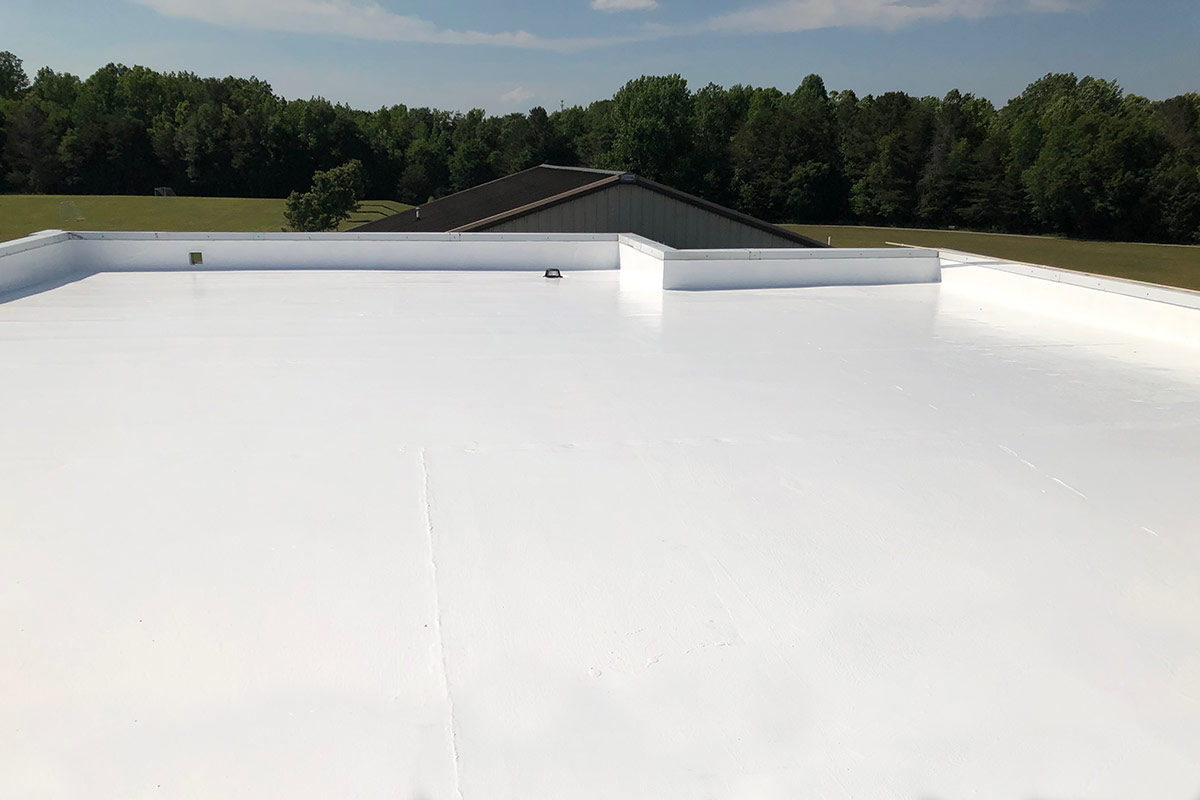
Silicone roof coating for Birmingham commercial flat roofs - fluid-applied restoration over sound TPO, EPDM, modified bitumen, and metal substrates with 10-year manufacturer warranty options. The work is planned around roof access, active building use, drainage, membrane condition, and the owner's timeline for repair, maintenance, or capital work.
Substrate Qualification — What Qualifies for Silicone Coating
We qualify a substrate for silicone coating through a four-step inspection: moisture core testing to confirm insulation is dry; seam and flashing probe testing to identify all open or soft seam segments; ponding water mapping to confirm drainage slope is adequate (silicone coating tolerates ponding water, but persistent ponding water over 48 hours indicates a drainage problem that the coating will not solve); and surface condition assessment to confirm the membrane is not delaminated, blistered, or sufficiently UV-oxidized that adhesion of the coating is compromised.
Substrates that typically qualify: EPDM membranes in good condition with sound seams and intact membrane body; TPO membranes with UV oxidation but intact seams; smooth-surface modified bitumen with intact cap sheet; metal roofing with intact seams and no significant rust through; and spray polyurethane foam (SPF) systems that need a new elastomeric top coat after the SPF has degraded its existing coating.
Substrates that disqualify: membranes with wet insulation under moisture core testing; membranes with open seams over 25% of total seam length; membrane bodies with active blistering or delamination covering more than 15% of the total surface; and any substrate where ponding water depth exceeds one inch across more than 10% of the roof area. We deliver the disqualification finding in writing with photographs. We do not push a coating proposal when the substrate does not qualify — it is a warranty problem for the owner at year two when the coating fails.
Application — What the Installation Process Covers
Substrate preparation is the majority of the value in a silicone coating application. Before any coating goes on, we repair all identified open seams with compatible tape or new membrane patch, apply new flashing at all parapet and penetration transitions identified as failed in the qualification inspection, clean the membrane surface of all dirt, debris, and contaminants, and prime the substrate if the manufacturer's application instructions call for primer based on surface condition.
We apply silicone coating by spray in two passes: a base coat to seal all seams and surface irregularities, followed by a finish coat to bring the total dry-film thickness to the manufacturer's warranty minimum — typically 20 mils for a 10-year warranty, 30 mils for a 15-year option where available. We measure mil thickness during application with a wet-film gauge and verify total coverage with a post-application dry-film measurement at ten sampling points per 10,000 square feet. Coverage documentation goes in the closeout package.
Birmingham summer application windows matter. Silicone coating requires ambient temperatures above 50°F and a dry substrate — which means we schedule applications in the morning before humidity peaks in July and August, and we do not coat over damp membrane regardless of the forecast. Most Birmingham summer weeks have a two-to-three-day window early in the week before afternoon thunderstorm season builds. We plan coating schedules around those windows, not around the contractor's production schedule.
Silicone vs. Acrylic Coating — Why We Specify Silicone
Acrylic coatings cost less per gallon than silicone and are sometimes proposed as the lower-cost coating option on Birmingham commercial buildings. We do not specify acrylic as a primary coating on commercial flat roofs for two reasons specific to the Birmingham climate: acrylic coatings degrade in ponding water, and Birmingham commercial flat roofs almost always have some ponding — the older commercial inventory was built with less drainage redundancy than current code requires. A silicone coating maintains its properties indefinitely in ponding water. An acrylic coating will begin to soften and erode after 48 hours of continuous water immersion.
The second reason is Birmingham's summer rainfall intensity. Central Alabama averages 54 inches of rain per year, and a significant fraction of that falls in high-intensity events during the summer thunderstorm season. The runoff rate on a commercial flat roof during a 2-inch-per-hour rain event is severe — acrylic coatings applied at less than full cure are vulnerable to washout during these events. Silicone cures faster and is rain-resistant within 30 minutes of application under most conditions. For Birmingham's unpredictable summer weather, that characteristic is not academic.
Frequently asked questions
How long does silicone roof coating last in Birmingham?
A 20-mil silicone coating carries a 10-year manufacturer warranty from most major manufacturers — Sherwin-Williams, GE Advanced Silicone 2, and Tremco are the systems we install most frequently. Real-world performance in Alabama conditions typically runs 12 to 15 years before re-coating is required to renew the warranty for another term. At re-coat time, the process is simpler and less expensive than the initial application because the substrate is already coated.
Can silicone coating be applied over an existing coating?
Yes, with qualification. If the existing coating is silicone and is still adhered, a re-coat application over the existing coating is a standard and cost-effective renewal. If the existing coating is acrylic and is partially delaminated or soft in ponding areas, the acrylic must be removed or mechanically abraded before the new silicone application — coating over a failing acrylic base does not extend the warranty and will re-delaminate at the same locations.
Does silicone coating help with Birmingham summer heat?
Yes. White or light-gray silicone coatings reflect 80 to 85 percent of solar radiation, reducing surface temperatures on treated roofs by 40 to 60 degrees compared to uncoated dark membranes. Birmingham commercial buildings with high HVAC loads — the Class A office and medical buildings in the 20th Street and UAB Medical District corridors — see measurable cooling load reductions after silicone coating application. We document the coating's solar reflectance index (SRI) on the closeout package for any owner pursuing energy compliance documentation.
How do you confirm a silicone coating qualifies for manufacturer warranty?
Manufacturer warranty on a coating application requires a pre-application inspection by a manufacturer-approved inspector, documentation of all repairs made before coating, wet-film and dry-film thickness documentation during and after application, and a post-application inspection by the manufacturer's field rep. We coordinate the manufacturer inspection as part of the standard coating project closeout — the warranty document is not delivered without the manufacturer's field sign-off.