Ponding water damage assessment and repair for Birmingham commercial flat roofs - drain failure cascading damage, insulation moisture mapping, deck corrosion evaluation, and permanent drainage correction. The first priority is protecting the building and determining whether the roof needs temporary dry-in, permanent repair, or a broader condition review.
Drain Failure and the Cascading Damage Sequence
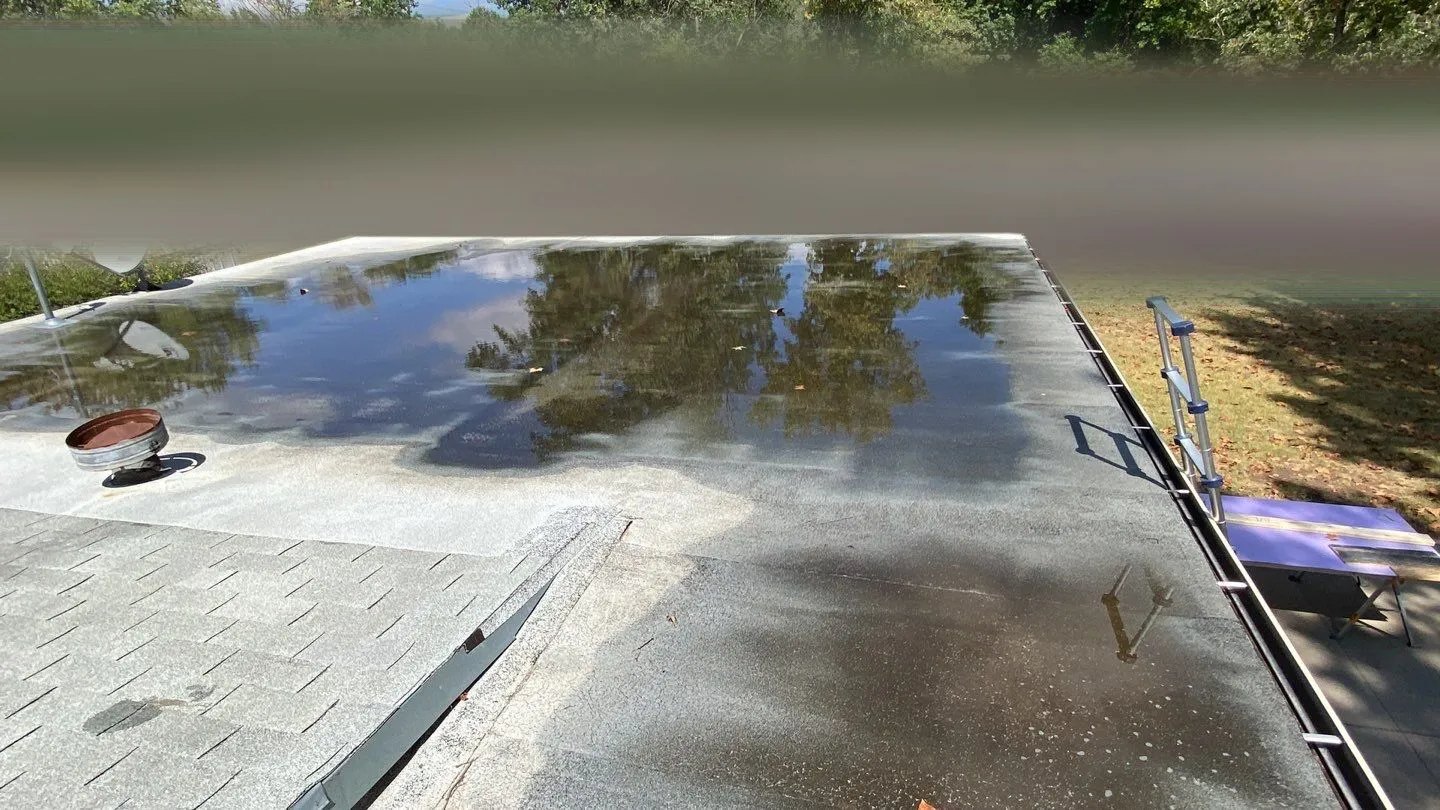
Most ponding problems on Birmingham commercial flat roofs trace to the drain system: undersized drain bodies for the roof area, drains packed with debris and sediment, corroded clamping rings that no longer seat the drain collar properly, and dome strainers that are missing or blocked. Birmingham's tree canopy — the oaks and pines that overhang older commercial buildings in Avondale, Highland Park, and the Homewood commercial corridor — contributes heavily to debris accumulation in roof drains, and buildings with tree exposure need more frequent drain clearing than the standard annual maintenance schedule.
A drain with reduced flow capacity does not just produce ponding. It produces a cascade: the ponding zone expands as sediment accumulates further around the drain, the membrane at the drain edge works under hydrostatic load it was not designed for, and the drain body itself — on older Birmingham commercial buildings, often a cast-iron two-piece drain from original construction — develops a clamping ring leak that allows water to bypass the drain body entirely and enter the building through the drain penetration. We inspect every drain on any roof showing ponding evidence, and we document both the drain condition and the downstream damage it has produced.
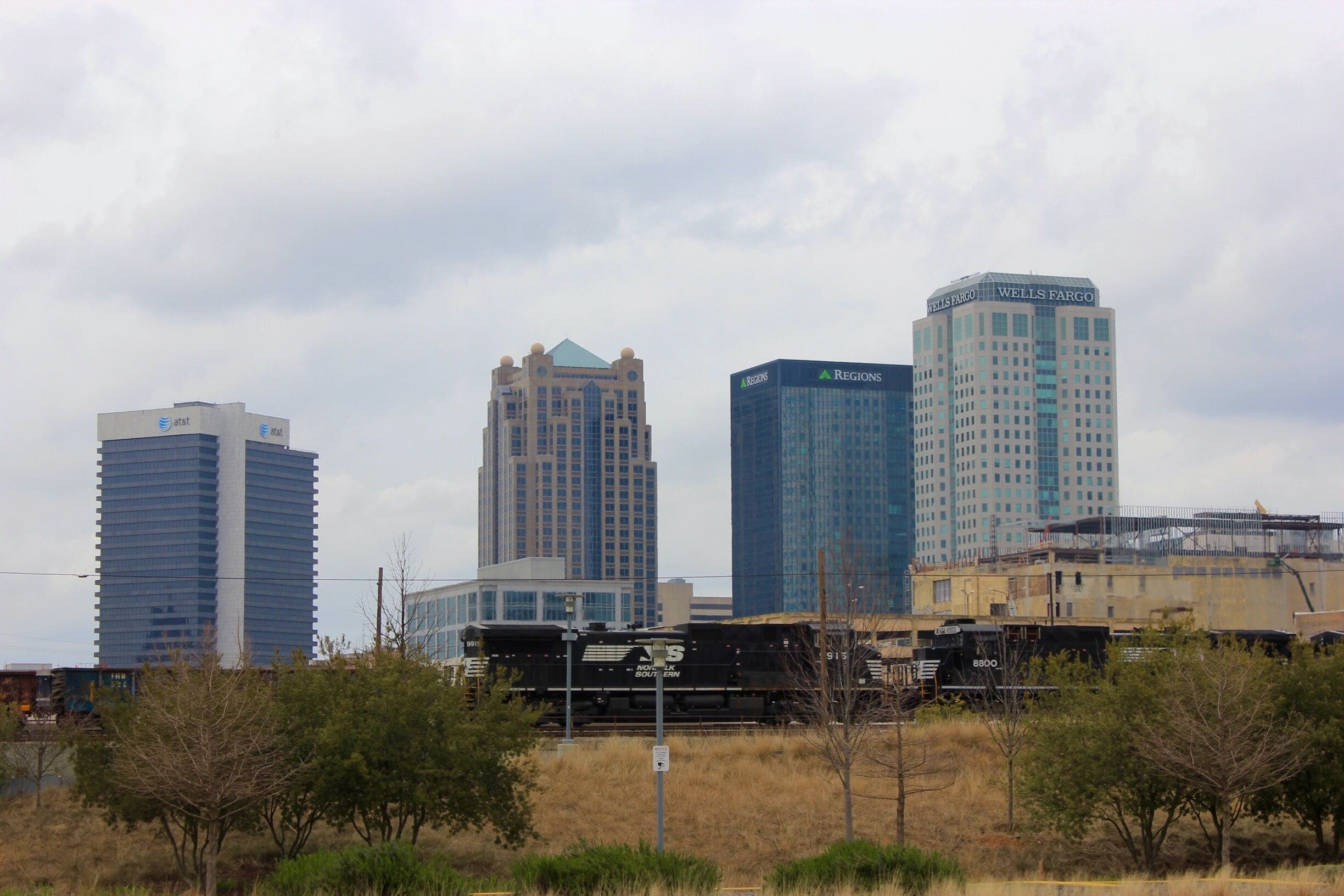
Birmingham's older commercial buildings in the downtown financial core and the 20th Street corridor frequently have original 1970s and 1980s drain systems. These drains were designed for the rainfall intensity assumptions of that era — not for the concentrated storm cell events that Alabama's changing climate produces. Drain capacity supplementation through additional scuppers or secondary drains is often the correct long-term scope alongside membrane repair.
Insulation Moisture Mapping in Alabama Conditions
Moisture saturation in roofing insulation cannot be identified from the surface — the membrane may look intact while the insulation below has been absorbing water for years. We map insulation moisture using infrared thermal scanning conducted at dusk or pre-dawn, when the temperature differential between wet and dry insulation is greatest. In Birmingham's climate, where nighttime cooling is often slow in summer months, we schedule scanning to maximize the thermal contrast.
The infrared scan identifies the spatial extent of moisture distribution. Core pulls at locations confirmed by the thermal scan quantify how deeply the saturation has penetrated through the insulation stack and whether the deck surface below is affected. A roof with insulation saturation confined to two ponding zones can often be repaired: cut out the wet material, replace with dry insulation, address the drainage root cause. A roof with saturation across 30 to 40% of the field — which we see on Birmingham commercial buildings where drainage problems have been deferred for five or more years — is a replacement candidate.
Moisture core locations are GPS-tagged and photographed. Saturation depth at each core is measured and recorded. This documentation serves both the repair scope and any insurance documentation if the ponding damage involves a coverable storm event.
Deck Corrosion Under Alabama Humidity
Metal deck corrosion under chronically wet insulation in Birmingham progresses faster than in lower-humidity markets. The combination of Alabama's ambient humidity and the sustained moisture in contact with the deck surface accelerates the oxidation process at the deck flute valleys — the low points where moisture concentrates. On Birmingham buildings where ponding has been a chronic problem for more than five years, we pull deck inspection ports at the worst wet-insulation zones before finalizing the replacement scope.
Mild deck corrosion — surface rust with no measurable section loss — is cosmetic and does not affect structural capacity. Moderate corrosion — rust with 25 to 50% section loss in the flute valley — requires structural engineering review before the replacement scope is finalized; the structural engineer must determine whether the section loss compromises the deck assembly's rated load capacity. Severe corrosion — perforation through the flute valley — is a structural deck replacement scenario before any new roofing work can proceed.
We communicate the deck condition category clearly before the replacement scope is written. Building owners who have been told a ponding problem is just a membrane issue have sometimes discovered the hard way that the deck is the actual scope-driving problem when the replacement crew opens the roof.
Frequently asked questions
Our flat roof has had standing water for years. How bad is the damage?
We cannot answer that without an inspection. The extent of insulation saturation, the degree of drain system failure, and the condition of the deck below the wet zones all determine the actual scope. An infrared scan followed by targeted core pulls gives us the moisture map we need to assess what is actually in the roof assembly.
Can ponding water damage be covered by Alabama commercial property insurance?
Ponding water damage from a specific storm event — drainage capacity exceeded by a defined weather event — may be coverable depending on your policy and how the damage is documented. Chronic ponding from deferred drain maintenance is typically not a covered loss. We document the damage and drainage condition clearly, and we note what appears to be acute event-related versus chronic deferred-maintenance damage. The coverage determination is for your adjuster.
What does actually fixing the drainage problem require?
Depends on the cause. Clogged drains: cleaning and rebuild or replacement of the drain body. Undersized drains: adding overflow drains or scuppers to supplement existing capacity. Structural low spots in the deck producing low points that drains cannot reach: tapered insulation overlay to redirect drainage. All three are often present on buildings with long-standing ponding. We scope the drainage correction and the damaged-material replacement together.