Wind damage documentation and repair for Birmingham commercial flat roofs - membrane edge lift, fastener pullout, ridge-pattern tears, and insurance-grade scope packages your adjuster can use. The first priority is protecting the building and determining whether the roof needs temporary dry-in, permanent repair, or a broader condition review.
How Wind Loads a Birmingham Commercial Flat Roof
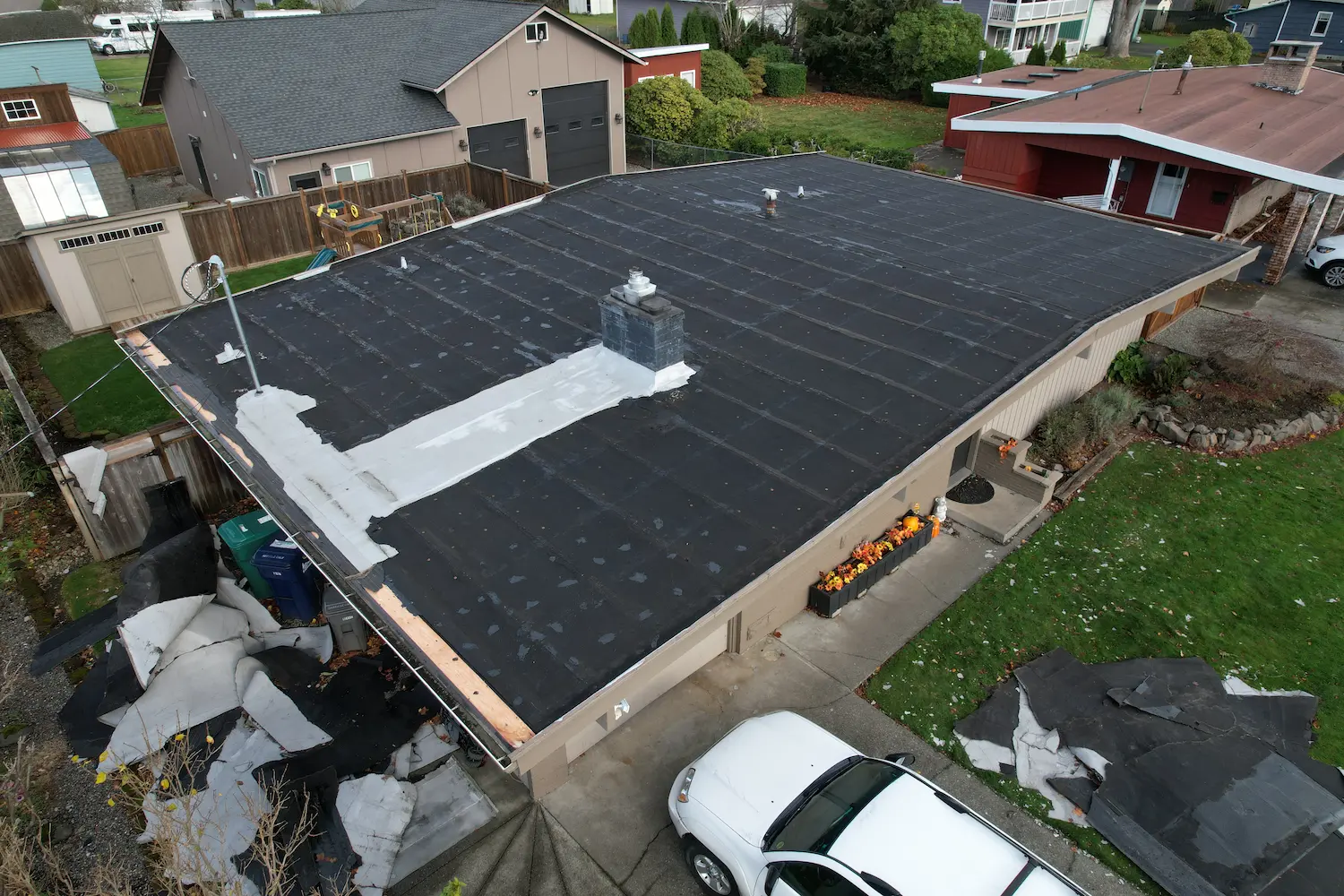
Wind pressure on a flat roof concentrates at the perimeter and corner zones — ASCE 7 maps these zones at roughly three times the uplift pressure of the field. Most wind damage on Birmingham commercial buildings starts at those corners and perimeter rows, where fastener density is supposed to be highest. When the attachment system has aged, or when the original installation underspecified the perimeter fastener pattern for the building's actual wind exposure, the membrane lifts at the corner and the pull-off sequence begins inward.
Ridge-pattern membrane tearing is a specific failure mode we document on older mechanically attached TPO roofs after Jefferson County wind events. The membrane billows between fastener rows under sustained high-load wind, and the flutter fatigues the membrane along the fastener line — producing a tear that runs almost geometrically straight across the field. That linear tear pattern is the signature of wind-uplift fatigue rather than a puncture or installation defect, and documenting the directionality of the tear against the event's wind track is part of establishing the wind peril for the claim.
Fastener pullout on buildings with metal deck that has experienced thermal cycling for 20 or more Birmingham summers is a documented failure mode. The fastener holes elongate at the deck attachment point, and when the wind loads the membrane, the fastener pulls through the deck instead of holding. We probe perimeter rows on any roof that sustained wind loading for pullout evidence — and we photograph every confirmed pullout location because the pullout pattern is the documentation that establishes wind-loading failure rather than installation defect.
Documenting Wind Damage for Alabama Carriers
Alabama commercial property claims handled by Allstate, State Farm, Alfa, and regional carriers all require specific documentation to attribute damage to a wind peril rather than to deferred maintenance or pre-existing condition. The documentation standard for a wind claim is different from a hail claim: we need to show uplift pattern, failure mode, zone distribution relative to the building's windward face, and correlation to the dated wind event.
We include wind speed records from the nearest ASOS weather station — Birmingham-Shuttlesworth International (BHM) and the Shelby County Airport (EET) both provide continuous wind monitoring — and where relevant, the SPC storm report for the event. For events that produced confirmed tornado touchdowns, we include the NWS Birmingham damage assessment survey where one was produced. The adjuster needs this attribution record to process the claim under the wind peril.
Fastener pullout documentation follows the same protocol regardless of carrier: we open the membrane at each suspected location, photograph the elongated hole against the fastener head specification, measure the hole diameter, and log the zone location. The concentration pattern tells the story — pullout clustered at the perimeter and corner zones, tracking the windward face, is wind-loading failure. That documentation stands on its own.
Repair vs. Replace After Wind Damage
Perimeter pull-off limited to one or two building edges, with the field membrane intact and fasteners holding in the field zones, is typically a repair scope: reinstall perimeter termination, reinforce the perimeter fastener pattern to current code density, reattach displaced flashing caps. This is the most common scope after a straight-line wind event on a building whose field attachment was sound.
Widespread fastener pullout across both field and perimeter zones, combined with ridge-pattern tears through the membrane body, is a replacement candidate. The membrane and attachment system are compromised to a degree that repair cannot restore the system's original wind-uplift performance. In that scenario, replacement is the scope that actually protects the building.
We document both scenarios the same way — zone diagram, photo log, pullout count by zone, and a written repair-vs-replace recommendation with the basis stated for each zone. What you do with the documentation in the insurance process is between you, your adjuster, and any public adjuster or attorney engaged.
Frequently asked questions
The roof did not blow off — why do we need an inspection after a windstorm?
Because the damage that produces leaks six months from now is often invisible from the parking lot. Perimeter lap seams that lifted and re-seated under wind load look intact from below but are no longer bonded. Fasteners that pulled through half the deck thickness are still holding but will not hold through the next event. A post-storm inspection documents current condition — for the claim and for your maintenance record.
How is wind damage documented differently from hail damage?
Different peril, different documentation. Wind damage requires documenting the uplift pattern, the failure mode — edge lift, fastener pullout, seam separation — and the correlation to the wind event's direction and speed. Hail damage requires impact density documentation at specific sites with size reference. If the event produced both perils, we document them separately, which matters for how the claim gets attributed under your policy.
The wind damage is in one corner. Can we just patch that?
Possibly. A localized corner repair is viable if the corner pull-off is the only damage zone and the field membrane is intact. We inspect the full roof before recommending a partial repair — because what looks like corner damage can be the visible end of a perimeter failure that extends further than the obvious damage zone suggests.