Structural roof damage assessment for Birmingham commercial buildings - deck and joist condition evaluation, load-bearing assessment after corrosion or impact damage, and structural engineering coordination. The first priority is protecting the building and determining whether the roof needs temporary dry-in, permanent repair, or a broader condition review.
Deck Damage Assessment — How We Work
Deck assessment after a damage event begins from below — walking the building's underside structure to identify any visible deflection, distortion, or deck panel displacement. Birmingham commercial buildings with exposed decks below an open warehouse or mechanical space allow direct inspection. Buildings with suspended ceilings require access panel entry or camera inspection at strategic locations that we identify based on the roof-surface damage pattern.
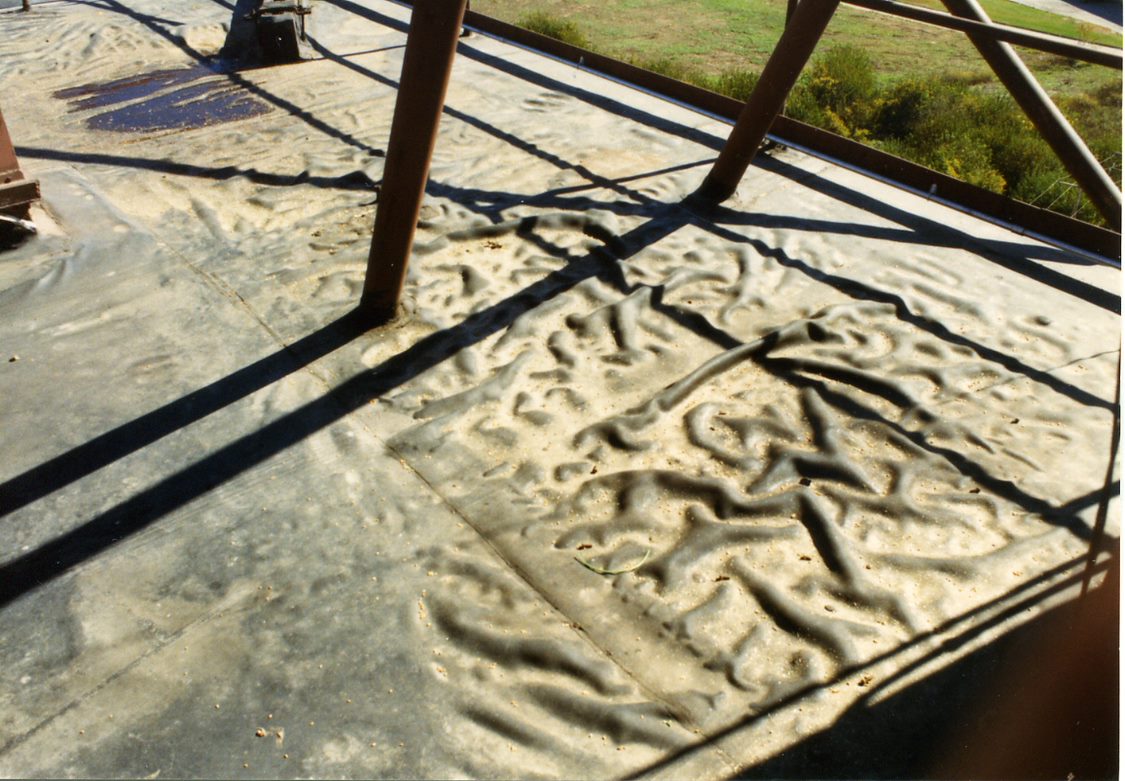
From the roof surface, we open deck inspection ports at every location where the event history or infrared moisture map suggests deck compromise. An inspection port is a cut through the membrane and insulation — typically a 12-inch square — that exposes the deck surface for direct assessment. We photograph the deck surface at each port, measure any visible section loss from corrosion or impact damage, probe for fracture or delamination, and document the condition against the deck's structural capacity criteria.
The output is a deck condition map: every inspection port plotted on the zone diagram with a condition rating — sound, marginal, or compromised — and the specific evidence for that rating. The structural engineer uses this map to determine where additional assessment is required and where deck replacement must precede any roofing work.
Corrosion Assessment in Birmingham's Climate
Metal deck corrosion on Birmingham commercial buildings advances faster than in drier markets because Alabama's ambient humidity maintains a moisture film on deck surfaces even when no standing liquid water is present. Under wet insulation — the condition produced by chronic ponding, unresolved leak damage, or membrane failures that were patched but not corrected at the insulation layer — the corrosion rate at the deck flute valleys is further accelerated. Buildings in the Avondale warehouse district, the older industrial corridors east of downtown, and the UAB campus periphery have substantial commercial deck inventory that is approaching or past 40 years of service life with varying levels of maintenance history.
We measure section loss at inspection ports against the undamaged top flange of the same deck panel to establish baseline thickness. Section loss findings are categorized: surface rust with no measurable loss is cosmetic; 25 to 50% flute valley section loss requires structural engineering review before the replacement scope is finalized; perforation through the flute valley is a structural replacement condition before any roofing work proceeds.
We note the estimated duration of moisture exposure — based on the extent of saturation we see in the insulation and on observable decay patterns in the deck — so the structural engineer has context for the corrosion rate assessment. A building with a 15-year history of unaddressed drainage failure has a different corrosion risk profile than one with a two-year leak event that was recently identified.
Joist Damage and Engineering Coordination
Open-web steel joists under Birmingham commercial roofs are exposed to moisture from deck corrosion above and from condensation below when vapor management is inadequate. Joist chord corrosion reduces bending capacity; web member corrosion reduces shear capacity. Neither can be reliably assessed by visual inspection alone — a structural engineer with joist capacity calculation tools is required for any condition beyond surface rust.
We identify joist condition concerns during deck port work: visible joists through the port opening, observable top chord corrosion in the immediate area, or deflection visible from below. We flag those conditions in the inspection port documentation and recommend structural engineering review at the flagged locations before the roofing scope is finalized.
We maintain working relationships with Birmingham-area structural engineering firms that have commercial building experience — firms familiar with the building inventory in the downtown corridor, the UAB Medical District, and the older industrial buildings in Jefferson County. When we flag a condition requiring engineering input, we make the referral and coordinate our scope timeline with the engineering review.
Frequently asked questions
How do we know whether our roof damage is a structural issue or a roofing issue?
Visual indicators from below: deck deflection, visible joist distortion, cracking or displacement at wall-to-deck connections. From above: large-scale membrane deflection that follows the deck panel pattern, significant ponding with no obvious drain failure as the cause. We walk both surfaces on every structural damage assessment and communicate clearly what we see and what it indicates.
Can you coordinate with our structural engineer directly?
Yes. We share inspection port documentation, core sample results, and zone-level condition maps with the SE. We are available for a joint site visit if the engineer wants to review specific conditions we have documented. Coordinating the roofing and structural scopes is faster and produces better outcomes than having the two disciplines work in sequence without direct communication.
If the deck needs replacement, does the building need to close?
Partial deck replacement — replacing compromised panels in specific zones with temporary shoring — can often be done while most of the building remains operational. Full deck replacement requires a construction sequence that the structural engineer determines. We build our roofing scope around that sequence.