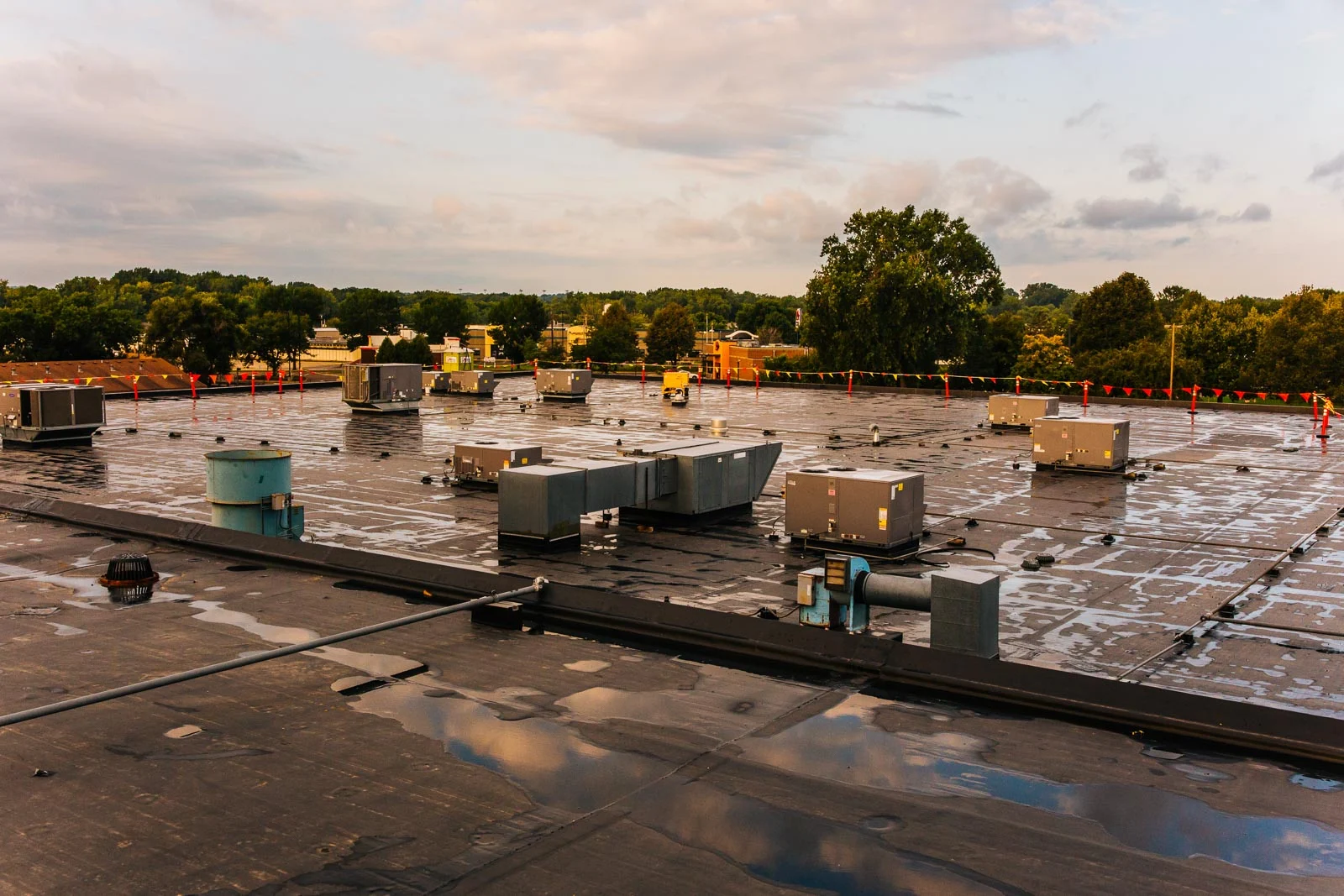
Diagnostic leak tracing and permanent repair for Birmingham commercial flat roofs - infrared scanning, water testing, common Birmingham leak source identification, and the difference between a real fix and a temporary patch. The first priority is protecting the building and determining whether the roof needs temporary dry-in, permanent repair, or a broader condition review.
How We Find the Source
Infrared thermal scanning is our primary diagnostic tool on Birmingham commercial roofs where the interior damage pattern does not immediately suggest the source location. We conduct the scan at dusk or pre-dawn, when wet insulation holds heat differently from dry insulation and the temperature contrast is maximum. The thermal image shows us the moisture distribution in the insulation — not just the leak point, but the full travel path from entry to the ceiling below. That map tells us where to look on the roof surface.
Water testing is our confirmation tool when the scan has narrowed the source to a zone with multiple candidates. We dam a section of roof, flood the zone, and watch the interior below for infiltration. The test takes time but produces a precise answer when the leak source is in a complex detail area with multiple potential entry points — a common situation on Birmingham's older modified bitumen buildings where prior repairs have been layered on top of each other over two or three decades.
Systematic visual inspection precedes every test. We photograph every anomaly in the suspect zone before any testing begins: open seams, flashing gaps, penetration seal failures, membrane splits, prior repairs that have failed or shrunk. The inspection gives us a priority list so the test starts at the most probable location, not a random one.
Common Birmingham Commercial Roof Leak Sources
Parapet cap flashing failure from freeze-thaw cycling: Birmingham parapets — particularly the masonry parapets common on the older downtown and Highland Park commercial buildings — move with freeze-thaw cycling at a rate different from the roofing membrane attached at the base. Counter-flashing separation at the wall face, cap metal displacement at the top edge, and base flashing separation at the membrane-to-parapet transition are all failure modes we see after every significant winter event. The February 2021 ice storm was particularly destructive for parapet flashing details that had never been evaluated for sustained below-freezing temperatures.
Pipe boot and pitch pan failures on older systems: Birmingham's older commercial buildings — the modified bitumen and BUR systems in Avondale, the older warehouse district east of downtown, and the 1970s office buildings in the 20th Street corridor — commonly have pitch pan penetration seals. Pitch pans are sheet-metal boxes filled with asphaltic or urethane sealant that dries and cracks over time. A cracked pitch pan channels water directly into the pipe penetration and is one of the most consistent sources of repeat leaks on older Birmingham commercial roofs.
Drain collar failure under Alabama rainfall volumes: Alabama's summer rainfall events — particularly the gulf-moisture-fed cells that can drop three inches in two hours — push drain systems beyond their design flow rate. Drain collars that seat correctly under normal flow conditions can separate under hydrostatic pressure from a backed-up drain body. We see this particularly on buildings in the UAB medical district and the downtown financial core where rooftop drain systems are original to construction from the 1970s and 1980s.
HVAC curb corner failures from humidity-driven expansion: Birmingham's persistent summer humidity creates a thermal and moisture cycling environment that is more aggressive for curb flashing details than the drier climates where most commercial roofing manufacturers test their details. Curb corner flashings — particularly pre-formed TPO corners on systems installed in the 2005 to 2015 window — shrink and pull away at the attachment edge faster in Alabama's climate than in lower-humidity markets.
Permanent Repair vs. the Temporary Patch
The difference between a permanent repair and a temporary patch is not primarily about material cost — it is about whether the repair addresses the failure mode or covers it over. Caulk applied over a dried pitch pan is a temporary patch: it bridges the crack but does nothing about the drying and shrinkage cycle that created it. Removing the pitch pan, installing a pre-formed pipe boot with a clamp-style termination welded into the membrane field, is a permanent repair that eliminates the failure mode.
We tell you which one we are doing and why. When a temporary dry-in is the correct first step — to stop active water entry while the permanent repair scope is being prepared — we say so and document the temporary work separately. We do not present a temporary patch as a permanent repair.
Frequently asked questions
We have had the same leak repaired twice and it keeps coming back. What is actually happening?
Most repeat leaks on Birmingham commercial roofs come from one of two situations: the wrong location was patched — the water entry point is somewhere other than where the repair was made — or the right location was addressed with a material that does not hold against the failure mode. We trace the source before we propose any repair. That step is what breaks the cycle.
Can you do a leak repair while the building is occupied?
Yes. Most commercial roof repairs are performed from the roof surface without requiring building interior access beyond confirming the stain location. We notify the facility manager of the work zone and timing. Hot-work permits are required for any heat welding or open-flame work — we pull those before the crew starts.
How do we know the repair actually fixed it?
We water test every repair before we leave the site. We flood the repaired zone, hold the water for a minimum of 30 minutes, and confirm with the building's interior that no infiltration occurred. The test result is photographed and included in the written repair report.
Could the moisture we see in the ceiling be condensation rather than a roof leak?
Possibly. Condensation within a roof assembly — particularly in Birmingham's humid summers when interior air is heavily conditioned — can produce interior moisture that mimics a rooftop leak. Infrared scanning helps distinguish the two: a rooftop leak produces wet insulation that maps above the interior moisture location; condensation within the assembly produces a different thermal pattern. We note condensation risk as part of every leak investigation on buildings with significant interior-to-exterior vapor pressure differentials.