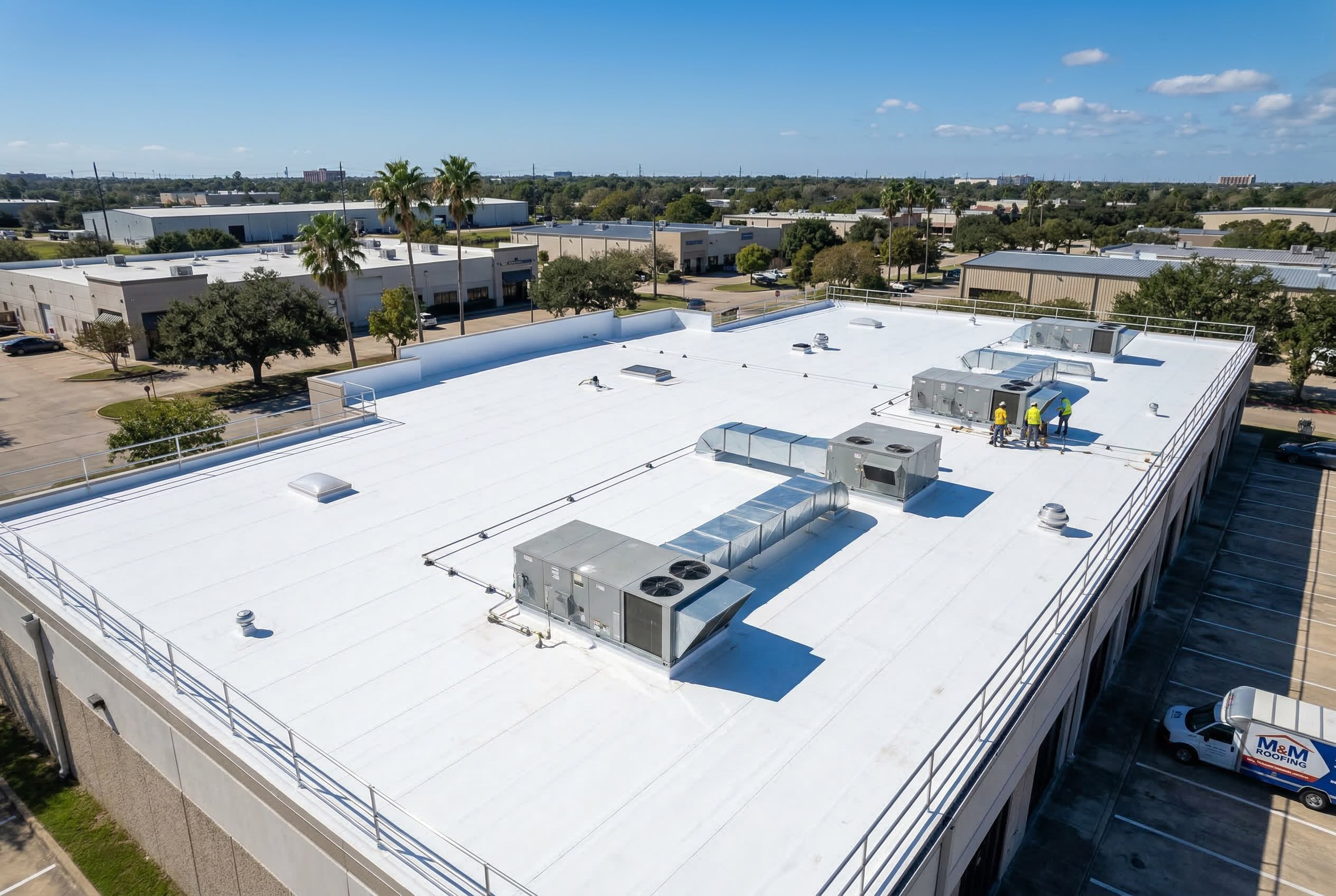
Single-ply commercial roofing systems for Birmingham and Jefferson County - TPO, EPDM, and PVC membrane installation, recover, and replacement with manufacturer warranty closeout for flat and low-slope commercial buildings. The work is planned around roof access, active building use, drainage, membrane condition, and the owner's timeline for repair, maintenance, or capital work.
System Design — Membrane Selection, Insulation, and Attachment
Membrane selection is the first decision and drives every subsequent specification. We select based on building use (standard commercial vs. restaurant vs. chemical exposure vs. high-traffic industrial), owner's warranty priority (20-year vs. 25-year NDL options), budget, and the building's operational environment. The Birmingham commercial buildings in the 5 Points South dining and entertainment corridor require grease-resistance assessment before specification — PVC is the correct membrane for restaurant buildings in that area regardless of the slightly higher material cost. The warehouse and distribution buildings near BHM airport and in the Center Point industrial parks are standard EPDM or TPO applications.
Insulation design: Alabama energy code (IECC 2021) requires R-25 minimum for low-slope commercial roofs. Most Birmingham replacement projects add polyiso primary insulation plus a cover board to The cover board specification matters in Jefferson County's spring hail corridor — HD polyiso or HD gypsum cover board provides the impact resistance that qualifies the system for insurance rating credit. We design the insulation stack against both energy code and hail exposure on every project.
Attachment method: Mechanically attached systems are the standard for most Birmingham commercial work — cost-effective, installed quickly, and designed against Alabama's wind-uplift requirements including the tornado-track exposure documented by the April 2011 superoutbreak. Fully adhered systems are used for complex geometry, deck types that cannot accept additional fasteners, or aesthetic requirements. We design the attachment against the specific building's wind exposure, not against minimum code as a default.
Manufacturer Warranty Paths in Birmingham
20-year NDL (no-dollar-limit) warranty is the standard for TPO and EPDM single-ply systems in Birmingham commercial work. NDL means the manufacturer will pay the full cost of repair or replacement if the system fails due to a manufacturing defect, without prorating the cost against remaining warranty years. This is the warranty standard that matters for commercial property owners — prorated warranties have much less value at years 15 to 20.
The NDL warranty requires: installation by a manufacturer-credentialed contractor, installation to the manufacturer's published details and specifications, a manufacturer field-rep warranty inspection at closeout, and documented biannual maintenance thereafter. We satisfy all four requirements. The warranty inspection is coordinated and completed before we consider the project closed — it is not optional.
Manufacturer selection for Birmingham projects: We install TPO and EPDM from Carlisle, Johns Manville, Sika Sarnafil, GAF, and Versico. PVC from Sika Sarnafil and Duro-Last. The right manufacturer for a specific building depends on the local manufacturer rep's responsiveness and warranty inspection schedule, the building's portfolio standard (some institutional owners — including UAB Health System affiliates — have standardized on specific manufacturers), and available system options for the specific application.
Single-Ply in Birmingham's Specific Climate Conditions
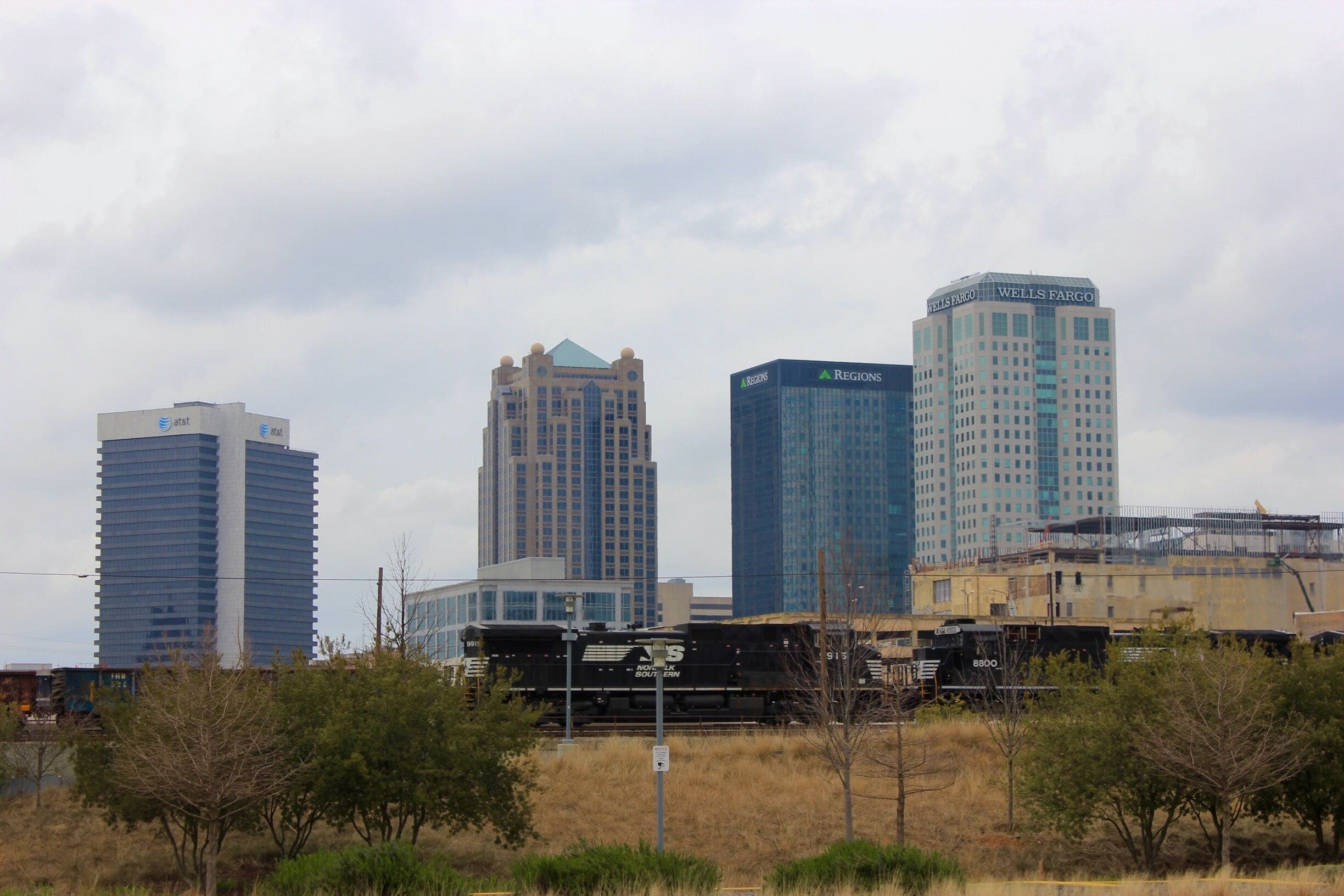
Summer heat management: Dark single-ply membranes in Birmingham reach surface temperatures above 150°F in July and August. White TPO and PVC membranes run 40 to 60°F cooler than dark membranes, which reduces cooling load for the building and slows UV-driven membrane degradation. For Birmingham commercial buildings with significant air conditioning loads — the UAB Medical District research buildings, the Regions Financial office complex, the multitenant office buildings in the Mountain Brook US-280 corridor — the energy performance benefit of white single-ply is real and should be documented in the system specification.
Spring hail preparedness: Jefferson County's spring hail corridor sees documented 1.5-inch to 2.5-inch hail in normal severe weather years. The 2020, 2022, and 2024 spring seasons all produced multi-county hail events. Our standard single-ply specification for any Birmingham building includes HD cover board, and we document the cover board type and impact rating at closeout so the owner can use it for insurance underwriting.
Tornado and wind-uplift: The April 2011 superoutbreak produced EF4 and EF5 wind speeds in portions of Jefferson County. Wind-uplift design for Birmingham single-ply systems is not a minimum-code exercise — it is a real engineering decision about what the building will experience over its service life. Our single-ply systems are designed against the conservative wind-uplift exposure that the county's documented tornado history supports.
Frequently asked questions
What single-ply membrane is best for a Birmingham commercial building?
For standard office, retail, and warehouse buildings: TPO 60-mil mechanically attached is the most cost-effective specification with a 20-year NDL warranty path. For restaurant and food service buildings: PVC due to grease resistance. For industrial and high-traffic buildings in the East Birmingham corridor: EPDM 60-mil or 90-mil depending on traffic intensity. For buildings where low-temperature flexibility is the priority: EPDM. The correct membrane depends on the building — not on which membrane is most convenient for the contractor.
How is a single-ply system different from a built-up roof?
Built-up roofing (BUR) is a multi-layer hot-mopped asphaltic system — typically three to five alternating layers of felt and hot asphalt, finished with a gravel flood coat. It is a proven system but labor-intensive to install and repair, and it is no longer installed in new Birmingham commercial construction. Single-ply systems are one layer of membrane — TPO, EPDM, or PVC — installed over insulation with a simpler, faster installation process and a cleaner manufacturer warranty path.
Can single-ply be installed over an existing roof?
Yes, if the existing roof's insulation is dry and the deck is sound. We pull moisture cores to verify the existing insulation before committing a recover scope. If the existing insulation has more than 25% wet cores, a recover over wet insulation voids the new warranty and accelerates the new system's degradation — replacement becomes the correct scope. If the existing insulation is dry and meets current R-value requirements, a single-ply recover can extend asset life 20 years at significantly lower capital cost than full tear-off.
Who do you work with in Birmingham for large commercial single-ply projects?
We work directly with building owners, property management companies, facility managers, and general contractors on new construction. In the downtown financial district, we have coordinated projects in the Regions Financial and Protective Life tower corridors. At UAB, we have done work on university health system facilities. In Hoover, we have scoped and managed projects in the Galleria commercial cluster. Project size ranges from 5,000 sq ft repair scopes to 200,000 sq ft industrial replacement projects — the process is the same regardless of size.